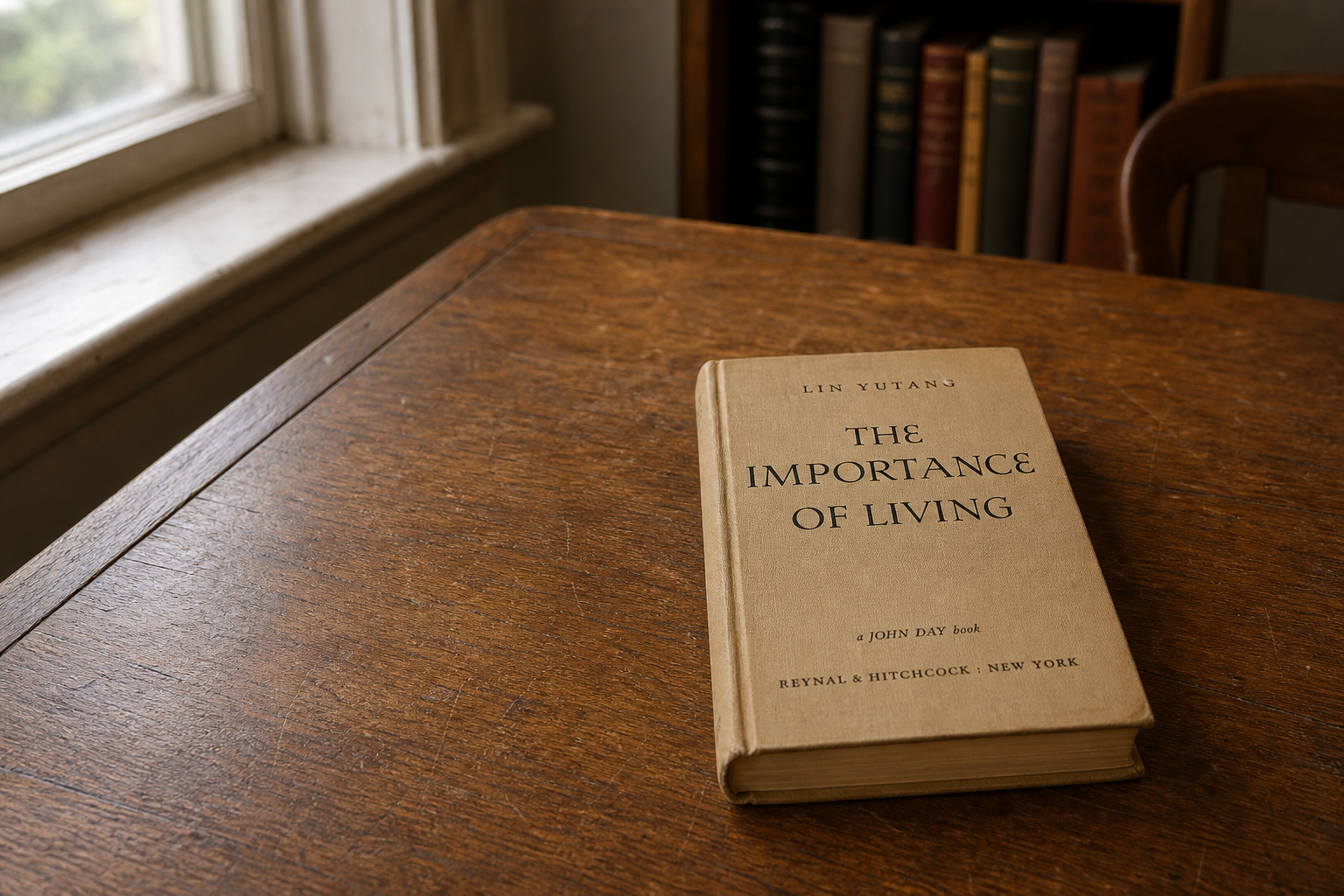
The Importance of Living, published in 1937 by the John Day Company and Reynal & Hitchcock, spent thirteen months at the top of American non-fiction lists. That fact is now almost embarrassing to remember, given how thoroughly it has been forgotten in Europe. We have grown so accustomed to importing American moods that we no longer notice when an older voice from another tradition has already said the necessary thing better.
One sentence carries the entire indictment: “The three American vices seem to be efficiency, punctuality and the desire for achievement and success. They are the things that make the Americans so unhappy and so nervous.”
Read that again slowly, because it is still impolite. Three centuries of Calvinist productivity religion, repackaged for the twentieth century as time management and self-realisation, condensed into one line by a man born in a Fujian village in 1895. He did not whisper it from a temple. He wrote it in English, in New York, for the audience whose entire self-image he was puncturing.
Lin Yutang had earned the right to the sentence. Educated at St. John's University in Shanghai, then Harvard, then Leipzig. Fluent in classical Chinese, English, German, and the cultivated registers in between. He moved with ease between the Republic of Letters and the Beijing teahouse, and he knew exactly which civilisational habits he was defending and which he was naming. The book is not a manifesto. It is a calm exposition of an entire ethic that had been lost in the West and was about to be lost everywhere else: the seriousness of leisure, the dignity of half-finished afternoons, the moral economy of doing less in order to perceive more.
Behind the prose is the Daoist conviction that the world arranges itself best when one stops trying to coerce it. Loafing, for Lin Yutang, is not idleness but a cultivated art. The scholar who lies under a tree with a cup of tea and an unsolved poem is doing more for civilisation than the executive who has answered three hundred emails before lunch. The point is not that nothing should be done. The point is that what most people are doing is not worth interrupting their lives for.
Eighty-nine years later, his three vices have done what vices do: they have multiplied and presented themselves as virtues. Efficiency has become the unquestioned measure of any institution, including those, like schools and hospitals, that should be measured by patience. Punctuality has been hardened into the synchronous tyranny of calendars, push notifications, and chat threads that no one is allowed to mute. The desire for achievement has metastasised into the cult of personal branding: the obligation to perform a winning life in public, twenty-four hours a day, in front of strangers, for the approval of a market that pays attention only by mistake.
The most depressing development is that the European who quietly resisted all this is now disappearing. We are racing each other to become a slightly less competent America: the same calendar pathology, the same metric obsession, the same fluorescent panic dressed in a more tasteful font. Asia, where Lin Yutang's instincts came from, is in many places running even harder in the same direction, with results no one wishing to be honest about Tokyo, Seoul, or Shenzhen can deny.
This is why the book deserves oxygen now. It is the cleanest antidote in English to the religion of optimisation. It treats the unhurried afternoon, the long meal, the cultivated friendship, the morning spent reading something useless, as the actual substance of a civilised life, rather than as decorations one is permitted between sprints.
Read Lin Yutang before the next productivity guru tries to sell you a morning routine. The cure for a nervous civilisation is not a better calendar. It is the slow, half-Daoist suspicion that most of what is being demanded of you was never worth doing at the speed at which it is being demanded.