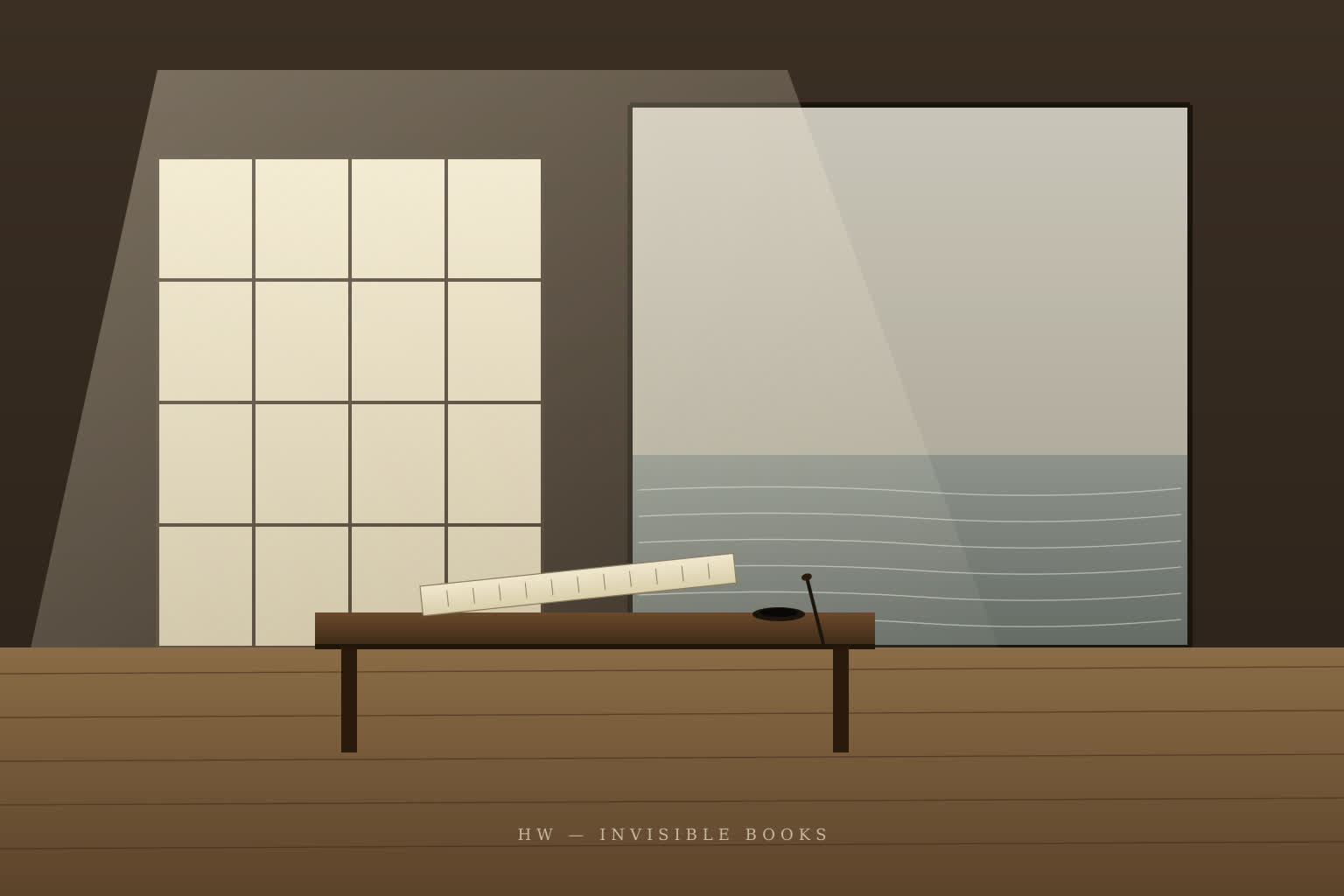
Kamo no Chōmei was born around 1155 into a family of Shinto priests attached to the Kamo shrines north of Kyoto. He was the sort of second-rank courtier of whom every civilisation produces thousands: educated, musical, mildly ambitious, thin-skinned about status, and just unlucky enough to watch his patrons die at the wrong times. He wanted a shrine appointment that would have kept him inside the polite machinery of the capital. He did not get it. So around the age of fifty he did something the twelfth-century Japanese court considered both eccentric and slightly obscene: he walked out. He built himself a hut ten feet square on Mount Hino, dragged in a few books, an inkstone, a lute, and a small wooden Buddha, and lived there until he died in 1216. In 1212 he wrote down, in three or four thousand words of the most quietly perfect Japanese prose ever produced, what he had seen.
He called the book Hōjōki, which just means An Account of a Ten-Foot-Square Hut. That is a genre-defying title. It is a memoir, a disaster chronicle, a Buddhist tract, a design brief, a piece of nature writing, and a farewell to a whole social world, all at once, in a text a serious reader can finish in an hour. It sits at the same altitude as Marcus Aurelius, Montaigne, and Pascal — and outside Japan it is barely read.
The opening is one of the most famous sentences in East Asian literature, and once you have heard it you never quite forget it:
“The flow of the river is ceaseless, and its water is never the same. The bubbles that float in its still pools now vanish, now form, and never linger long. So too are the men and their dwellings in this world.”
Chōmei had earned that sentence. Before he ever picked up a builder's hatchet, he had lived through five catastrophes that emptied a large fraction of Kyoto: the great fire of 1177, which took a third of the city in a single night; the whirlwind of 1180 that unroofed streets like folded paper; the forced move of the capital to Fukuhara that same year, which uprooted the entire aristocracy for a few catastrophic months and then returned them to a house they no longer recognised; the famine of 1181, in which he watched corpses stacked along the Kamo River in numbers he could not count; and the earthquake of 1185, which brought down the great Buddha at Tōdai-ji and rattled the whole plain for weeks. He is the earliest disaster reporter in the Japanese language, and he does not moralise. He describes. Only after the descriptions does he draw the conclusion: whatever is built at that scale, in that place, on those terms, will not stand. Neither the buildings, nor the households, nor the reputations.
His answer was not a philosophy. It was a hut. A single room, ten feet by ten feet, seven feet high. Walls of woven grass, a thatched roof, a plank floor. Shelves for the sutras. A brush, an inkstone, a folded quilt. A lute and a set of pipes on one wall, a small image of Amida on another, a fern-and-bracken bed. Enough. He describes the construction in careful sentences, because he wants a reader eight hundred years later to understand that this is not renunciation as pose but renunciation as engineering. The hut is portable: he can take it apart and rebuild it in a day if a landlord objects. It is unheatable in serious cold and leaks in serious rain, and he says so. It is also, at last, honestly the size of the life he can actually attend to.
What he keeps returning to, in the second half of the book, is the arithmetic of comfort. A great house, he says, requires a great household to keep it standing. Servants who cannot be trusted. Neighbours who must be impressed. Rivals who must be flattered. Officials who must be paid. A big house is a small king’s worth of anxiety, and it demands its tax in vigilance every hour of every day. A hut requires none of this. He carries his own water. He gathers his own firewood from the branches the mountain wind has already broken. He plays his lute badly and no one is offended. He can walk the mountain in the morning, chant the nembutsu in the afternoon, read the Wakan Rōeishū in the evening, and go to sleep with nothing owed to anyone. He notices, with a slight embarrassment, that he is happier than he was as a courtier. Then he immediately warns himself that even this happiness is an attachment, and therefore also a form of debt.
That last turn is what makes Hōjōki not a lifestyle brochure. It is written from inside a religious grammar, not against it. Chōmei knows perfectly well that a Buddhist recluse is not supposed to be pleased with his hut. The whole point of the exercise is to loosen the grip of the world, and if the grip merely transfers from mansion to hermitage, nothing has been achieved except a change of scenery. He ends the book with a self-reproach: “My tongue speaks the nembutsu two or three times, and then falls silent.” He admits that he has become attached to his ten feet square. He does not resolve this. He simply notes it, dates the manuscript, and stops writing.
Almost everything a person needs to think about scale is already in that little book. Chōmei is the first serious European or Asian writer, that I can find, to make the argument that a civilisation is legible in the size of the units in which ordinary people live: their rooms, their households, their loyalties, their debts, their tools. When those units grow larger than a person can actually attend to, they start leaking their real cost onto other people, and eventually the whole system runs on the fiction that no one is paying. The 1181 famine was, among other things, an accounting failure at scale. Our century is running the same experiment with much better instruments and a great deal more oxygen. The corpses will not, this time, be stacked on the banks of the Kamo. But something else is being stacked, in silence, at the edges of a system that can no longer see its own edges.
Read him now, quietly, in an afternoon. Two good English translations are easily found: the Yasuhiko Moriguchi and David Jenkins version has the plainest prose; the Anthony H. Chambers version, packaged with Chōmei’s later Hosshinshū, has the finer scholarly apparatus. Either will do. The book is short enough that you can, if you want, copy the opening lines out longhand on a single sheet of paper and pin them somewhere you will pass in the morning. Do it. Then, over the following weeks, catch yourself in the middle of a sentence about your life and ask, without drama, whether the scale of the thing you are describing is actually the scale of the life you can hold. If the answer is no, you have already begun to read Chōmei correctly. The hut, remember, is portable. He built his in a day.