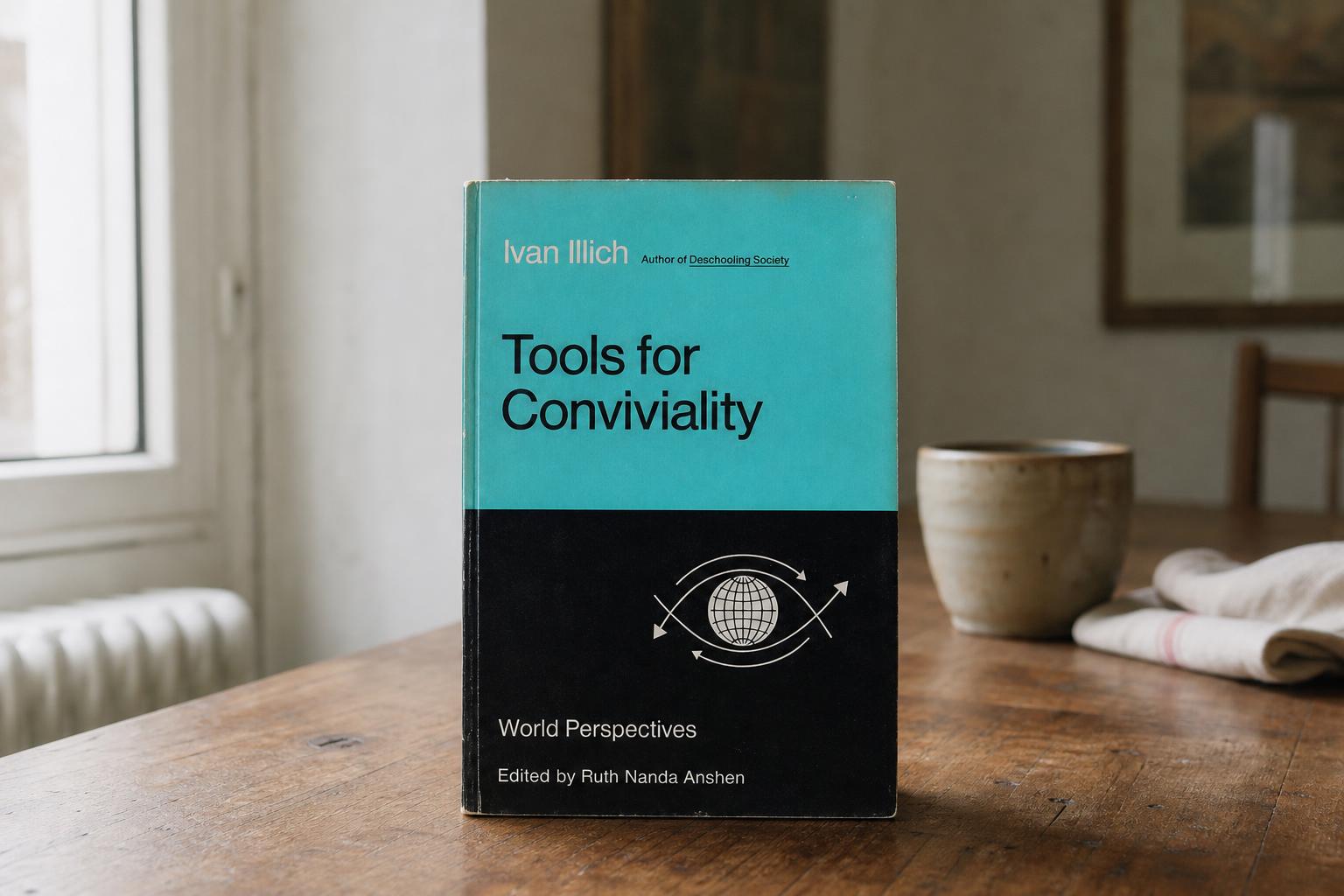
Ivan Illich worked this argument out in Tools for Conviviality, published in 1973 from Cuernavaca, Mexico, where he had spent a decade running a peculiar institute that collected priests, radicals, and people too uncomfortable for the institutions that had made them. The book is short, compressed, and almost entirely unassigned.
He named the mechanism "counterproductivity." The cleanest example is transport. Beyond a certain density of cars, average city-wide speed drops below bicycle pace; non-drivers are structurally excluded; and what promised liberation now consumes more hours of human life in commuting, parking, and maintenance than it returns. The car has not enhanced movement. It has made movement impossible without itself.
He ran the same logic through medicine, schools, and communications. The institution manufactures the need it was built to satisfy. Schools teach people that learning requires certification. Hospitals teach people that recovery requires hospitalization. The service occupies the capacity it was supposed to supply.
What Illich wanted — the "convivial tool" — was the inverse: the bicycle, the telephone in its early form, the printing press before consolidation. Tools that extend what a person can do alone or with others, without requiring institutional mediation, without making the user dependent, without generating a market for their own remedy.
He wrote this fifty years ago. He was not writing about software. But the structure he described is not technology-specific. A tool that genuinely extends reach in one mode can, at scale and with dependence, begin degrading exactly the capacity it was built to serve. The user does not usually notice when this happens. The dependence arrives before the loss becomes legible. The alternative has already been extinguished.
Tools for Conviviality is out of print in most editions. A scanned copy circulates.
Read it before reaching for the next tool.