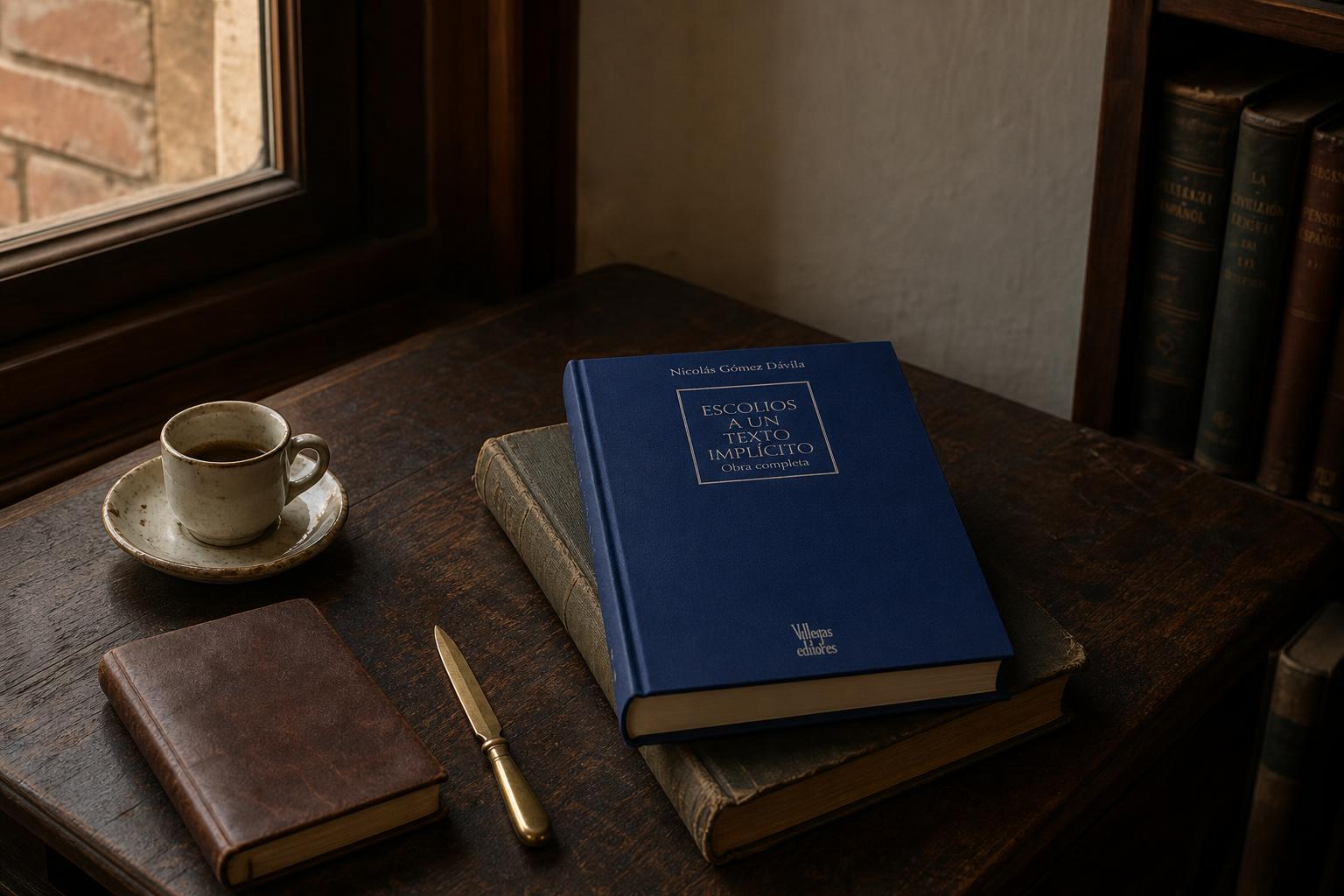
Nicolás Gómez Dávila — Don Colacho to a handful of friends — was born in Bogotá in 1913 to a wealthy textile family, sent to a French Benedictine school in Paris, returned with the manners of a nineteenth-century European and a horseman's broken hip that kept him at home for the rest of his life. He read in Latin, Greek, French, German, English, and Italian. He bought books obsessively. By the time he was old he was sleeping in a room surrounded by some thirty thousand volumes and writing every morning before dawn.
He almost never left Colombia. He refused chairs at the Sorbonne and the National University of Colombia. He declined an ambassadorship. When friends founded the University of the Andes in Bogotá, he helped — and then refused to teach. He never sat for a magazine profile. He gave one short television conversation in his eighties and even that was wrung out of him. He published two small books in the 1950s that nobody read, then went quiet for two decades, then began releasing the Escolios in 1977 — five volumes of aphorisms over fifteen years, issued by a small Bogotá house, almost as private documents.
The form is the argument. Each scholium is a single line, sometimes two, occasionally a short paragraph. They are not built into chapters. They are not arranged by theme. The reader walks the corridor and a sentence reaches out of the wall.
“El mundo moderno no será castigado. Es el castigo.”
The modern world will not be punished. It is the punishment.
That is the line that travels best. It is also the line that makes most of the surrounding library understandable. Gómez Dávila does not believe that history will eventually correct the present arrangement by some external blow — a war, a collapse, a divine intervention. He believes the present arrangement is already the blow. The flattened attention, the cheapened speech, the religion of progress without any object of progress, the political life that has become an industry of grievance and a market for promises, the slow extinction of any vertical relation in which a human being could measure himself against something higher than his own appetite — these are not symptoms. They are the sentence. We are inside it.
He writes from the right, but the right that does not exist any more: aristocratic, Catholic, Latin, severe, untouched by the suburban populism that has since taken the word. He is closer to the Spanish baroque, to Pascal, to Joubert, to Cioran without nihilism, to Donoso Cortés in a calmer mood. He despises the liberal centre because it has nothing to defend; he despises mass democracy because it flatters what should be challenged; he despises the revolutionary because he has confused his envy with a theory. He is harder on his own side than on the enemy. Many of his sharpest lines are aimed at the bourgeois Catholic who turns the faith into respectable furniture.
You can disagree with almost everything he believed and the book will still cut you, because what he is really doing — under the political surface — is teaching a posture of attention. The aphorism is a discipline. It refuses the long argumentative essay because the long argumentative essay has, in the modern academy, become a way of saying nothing carefully. It refuses the manifesto because the manifesto sells. It refuses the book-as-product because the book-as-product is part of what he is diagnosing. The form punishes evasion. There is no room in a single sentence to clear your throat.
And so his readers, when they finally meet him, read slowly. One scholium a morning. The page is not consumed; it is sat with. Some lines arrive immediately. Some sit there for a year before they open. Some never open at all; you walk past them and they wait. Walking past is allowed. He is not pleading for your attention. He is offering an instrument.
He is also, quietly, an antidote to the noise of our own time. Everything around us is built to extract one more minute of consent: another scroll, another headline, another outrage, another opinion delivered in the voice of someone who has just learnt the subject that morning. Gómez Dávila is the opposite of that machinery in every way. He waited decades to publish. He wrote in a marginal language for a marginal audience. He refused the apparatus of fame at every step. He died in 1994 still largely unread. He is one of the few twentieth-century writers whose biography is itself a small refusal of the era he was diagnosing.
He should be read now for two reasons. The first is therapeutic. After a week inside the public conversation — its frantic pieties, its uniform vocabulary, its market in indignation, its addiction to its own reflection — to open the Escolios is to sit suddenly in a quiet room with someone who is unimpressed by all of it. He clears the ear. He restores a sense of altitude. Some books make you faster; this one slows you until your own thinking can hear itself again.
The second is harder and more important. Gómez Dávila is one of the few writers who tells you, with no consolation, that the dignity of a life is not negotiated with the spirit of its age. You owe nothing to a regime of attention that wants you flattened, distracted, indignant, easily moved, and easily replaced. You owe something — exactly what, he leaves to you to discover — to whatever in you is still capable of an interior life. Most of the modern world is organised against that capacity. He is organised for it.
Read him in small portions, in the early hours, before any screen. Keep a notebook. Mark the lines that cut. Return to them in a month. The book does not announce itself; it deepens. Like the man who wrote it, it waits for the reader to be quiet enough to hear it.