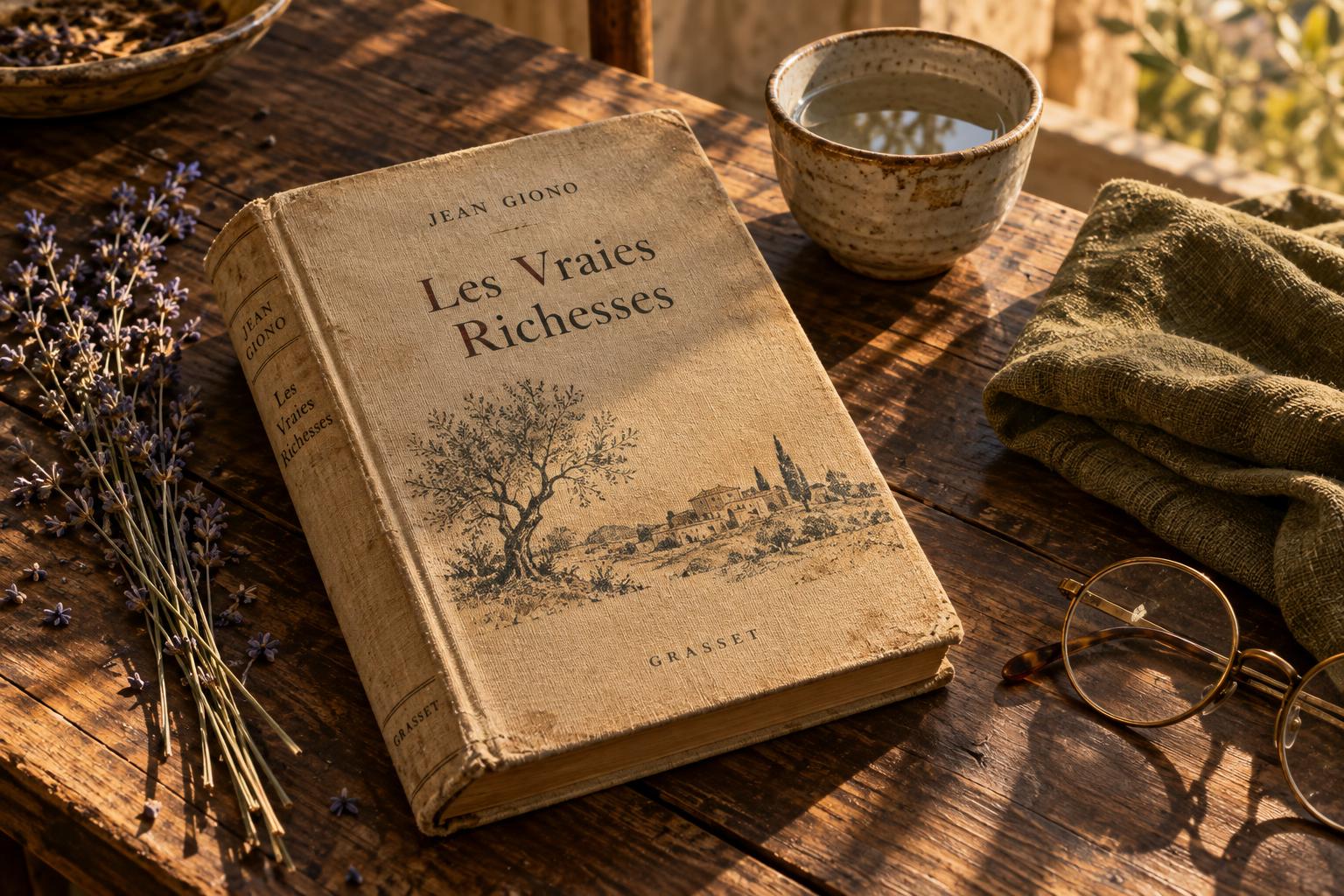
Jean Giono is one of those writers whose international standing never quite caught up to his quality. In France he is read as a regional master, a Provençal with hills and shepherds. Outside France he is a footnote attached to Le Hussard sur le toit or to the small posthumous parable L'Homme qui plantait des arbres. His stronger books, the ones with teeth, sit on the shelves of serious readers in Marseille and Manosque and almost nowhere else. Les Vraies Richesses, published by Grasset in 1936, belongs to that quieter, harder shelf.
It is a short, strange book. Part essay, part sermon, part pastoral travelogue, part political pamphlet. It was written out of the Contadour meetings — the long walks and shared meals Giono held with a few young men and women on the Lure plateau in the mid-thirties, in the exact years when Europe was arranging itself for its next slaughter. The book was his attempt to say, plainly, what he thought a life was for before any of that arrived.
The sentence I return to is one line, placed almost without warning in the opening pages:
“La seule vraie richesse est celle de l'homme.”
The only true wealth is that of the human being.
Giono is not being sentimental. He writes it with the dryness of a man counting sacks of grain. The whole book is organised against a specific enemy, which he names without euphemism: le dieu Argent, the god Money. Not capitalism as a system to be theorised, not banking as a technical object to be reformed, not inequality as a statistic to be redistributed. The god Money. He treats it as an actual deity — jealous, consuming, demanding of sacrifice — and he insists that his century has quietly built its temples, trained its priests, and begun to feed its own children into the fire.
It is a brave diagnosis for 1936. The fashionable intellectuals of Paris were busy choosing between two totalising answers to the same question of production. Giono refuses the question. He will not debate whether the god Money ought to be publicly owned or privately managed. He wants to know how a man feeds his family, repairs his roof, keeps his wife content, raises his children, and dies without having spent his only life serving a number on a ledger. The famous Giono gesture of the book is to compare the ledger of a bank to the ledger of a small farm: the one records abstraction, the other records bread, lavender, wool, cheese, firewood, water, work, friendship, hours in the sun. He asks the obvious, unanswerable question. Which of these two is actually wealth?
Then he does something harder. He refuses to romanticise the farm. Giono is not a village idiot in berets. He knows peasants are also capable of greed, superstition, and petty cruelty. He is not proposing a return to any paradise, because he does not believe one existed. What he is proposing is a different measure. A life is rich if, at its end, it contained real meals, real conversations, real work done with real materials in the company of real other people, under a real sky, in a real place. A life is poor if it contained only the pursuit of numbers, however large those numbers eventually became. This is not nostalgia. It is accounting.
The force of the book, in 2026, is in how exactly it predicts us. Giono describes a near future in which the god Money will have persuaded human beings to measure their lives by a scoreboard they cannot see and did not design, to defer their actual existence to a retirement that will arrive, if at all, as fatigue, and to confuse the acquisition of objects with the having of a life. He describes the technical servitude of a people who still believe they are free because they can choose between brands of their own captivity. He is not predicting consumerism — he is predicting the inner shape of consumerism. The dignity collapse. The spiritual thinness. The slow erosion of the capacity to recognise what is actually valuable when it is not priced.
It is worth remembering that Giono went to prison for his pacifism in 1939 and again in 1944, and spent the rest of his life watching France decide how to narrate what it had done. He wrote Les Vraies Richesses while he still believed, naively, that if the sentence were simple enough, enough men would hear it. The sentence was simple enough. Not enough men heard it. Our century has had the manuscript on the table for ninety years and has, mostly, used it as a coaster.
Read him now, in the thinnest edition you can find, outdoors if possible, slowly. Then look at your own week. Where did the actual richness sit? In the meal cooked without hurry, in the hour given to a child's question, in the walk after rain, in the hand kept on a friend's shoulder, in the small competent repair of a small ordinary thing — or in the numbers that moved on a screen on your behalf, in the servitudes you have begun to call a career, in the acquisitions whose weight you have begun to call a life. Giono wrote the book so that the question could be asked in that order, and in no other.
The god Money is still being fed. It will go on being fed. One is not obliged to kneel. A life organised around the small true wealths — bread, water, work, friendship, attention, a window that opens, a room that is one's own, a few people one actually loves — is already, in Giono's exact and unfashionable sense, rich. The ledger simply has to be the right one. He wrote that in 1936 for people who had not yet seen what was coming. He also wrote it, I now suspect, for us.