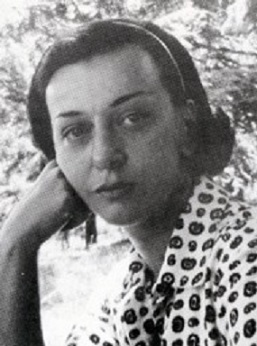
Vittoria Guerrini, who published under the name Cristina Campo, was born in Bologna in 1923 and died in Rome in 1977, aged fifty-three. She suffered from a congenital heart defect, lived most of her life inside the small radius of a few rooms, refused journalism, refused the literary parade, refused even to gather her own essays into a book. Gli imperdonabili, the volume by which she now travels, appeared ten years after her death, assembled by friends from the pieces she had been unwilling to bury and unwilling to display. Adelphi has kept it in print ever since. Last year New York Review Books finally let her speak English in The Unforgivable.
One sentence is enough to understand what she was guarding:
“Attention is the only path to the unsayable, the only path to mystery. In fact, it is firmly anchored in the real, and only through allusions hidden in reality is that mystery manifested.”
That is from her essay Attenzione e poesia. It is not a slogan, and not a creed. It is the working principle of a woman who treated reading, prayer, translation, and ordinary perception as the same act performed at different temperatures. She believed an attentive mind can still catch the tremor that the noisy mind cannot — and that the price of that catch is patience, silence, and a refusal to be entertained.
The unforgivables of her title are not sinners but the few stubborn souls who decline the bargain a modern century offers. They will not lower their standards in exchange for relevance. They will not accept that ceremony, fairy tale, liturgy, perfection of form, or the cultivation of attention are decadent luxuries. They keep on insisting that beauty is a serious instrument of knowledge, not a wallpaper. To a civilisation that has confused inclusivity with mediocrity, they remain genuinely unforgivable.
This is why Campo deserves oxygen now. We have built a culture in which attention is harvested rather than practised, in which form is a marketing layer, in which liturgy survives mostly as nostalgia, and in which the word perfection is half-banned for moral reasons. She would have understood, without surprise, why so many people now live in a low-grade cognitive fog. She had already seen the early rooms of that house being built.
Read her, too, because she resists almost every contemporary tribe. She is Catholic, mystical, monarchically minded, but with a horror of pious chatter. She translates John Donne, William Carlos Williams, Simone Weil, and the Indian fairy tales with the same severity. She loves order and detests bureaucracy. She fights against the post-conciliar reform of the Mass without becoming a reactionary mascot. She insists, in the middle of the twentieth century, that imperfection is interesting only because perfection is real.
The lesson is not aesthetic comfort. It is closer to spiritual hygiene. Attention is not a wellness practice. It is the discipline by which a person stops being a piece of the surrounding clatter and becomes a witness to what is actually there. Without it, the inner life thins into opinions about other people's opinions, and the outer life into managed appearances.
Open Gli imperdonabili on any page and you will find a sentence that looks small and turns out to be load-bearing. Then close it, and notice that the room is quieter than it was a moment ago. That is the work she came to do.