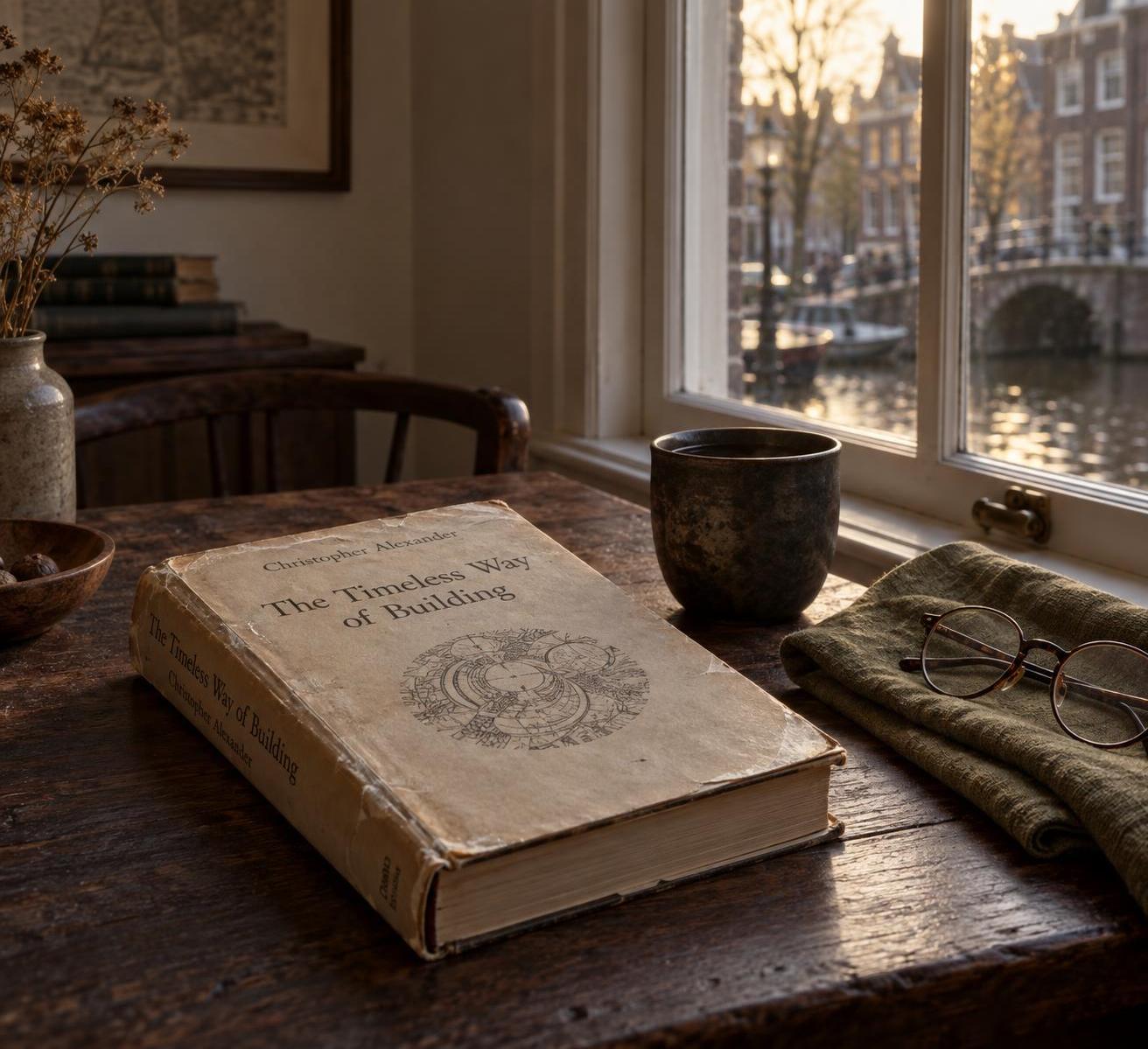
Christopher Alexander is one of those rare writers whose reputation is entirely out of proportion to the number of people who have actually read him. Architects half-remember his name from a semester of theory; software people know he is somehow the ancestor of design patterns; new urbanists cite him as a saint they do not quote. Meanwhile the actual book sits on the second shelf, cream jacket faded, spine cracked at the middle, and almost no one opens it after the first hundred pages. The book is The Timeless Way of Building, Oxford, 1979 — the first volume of the trilogy that also contains A Pattern Language and The Oregon Experiment, and by a wide margin the least read of the three.
Alexander was, at the time, a Cambridge-trained mathematician who had turned into a Berkeley architect and refused to behave like either. He built things — a school in Japan, a farm in Mexico, a shelter for the homeless in San Jose, a campus at the University of Oregon — and he wrote about buildings the way a botanist writes about plants: as things that are either alive or not. The prose is unfashionable now in a very particular way. It has short paragraphs. It repeats. It has the cadence of a man patiently trying to convince the reader of something he already knows the reader half-suspects.
The sentence I keep returning to is on the first page of chapter two:
“There is a central quality which is the root criterion of life and spirit in a man, a town, a building, or a wilderness. This quality is objective and precise, but it cannot be named.”
Read it slowly. He is not being coy. He means every word of it.
Notice, first, what he refuses. He refuses to say that beauty is subjective. He refuses to say it is a matter of taste, or of era, or of the eye of the beholder, or of the school one attended. He calls the quality objective and precise — words a self-respecting late-twentieth-century academic was not supposed to use about aesthetic experience, and which cost him a great deal of professional oxygen in exchange for a private conviction he considered non-negotiable.
Notice, second, what he refuses to do with it. He refuses to name it. Not because it is mystical, but because naming it, in his experience, always narrows it: call it harmony, and you lose the awkward beauty of a fisherman's chapel; call it order, and you lose the wild garden; call it life, and the word is already scuffed. Through the book he uses a rotation of temporary names — the quality without a name, alive, whole, comfortable, free, exact, egoless, eternal — none of which he defends as sufficient. He asks the reader instead to point. Point at the courtyard where you actually wanted to sit. Point at the corner of the kitchen where the light lands right. Point at the alley in a small town in the Peloponnese, or in a hill village in Umbria, or in a fishing hamlet in Zeeland, where something in you settled the moment you rounded the corner. That, he says, is the quality. Its absence is the disease of most of what we have built since 1945.
And here is what makes the book still, forty-six years later, an invisible book. Alexander is not writing architectural theory. He is writing a moral philosophy that happens to arrive through doorways, windows, courtyards, staircases, alcoves, and market squares. He argues that the modern building industry — the modern anything industry, if we are honest — produces objects that fail the quality test not because their makers lack skill but because their process is wrong. Wholes cannot be assembled by adding parts drawn on a distant table by people who will not live with the result. They emerge, slowly, from repeated small acts of adjustment by people who know the place, know the use, know the neighbours, and are allowed to change their minds. Take that permission away and you get exactly what a European suburb built between 1965 and 2015 tends to look like: technically competent, legally compliant, spiritually dead.
This is why the book has been quietly buried by two very different constituencies. The professional architects buried it because it questions their monopoly on wholeness. The software people, who mined its middle volume for the notion of a pattern, buried it because the first volume contains the part of Alexander they could not repackage: the insistence that patterns without the quality are worthless, and that the quality can only be recognised by a person who has permitted themselves to be present. You cannot ship the quality without a name in a framework. You cannot A/B test it. You cannot roll it out.
What makes the book newly urgent in 2026, and not merely nostalgic, is that a generation of European buildings is now going up under algorithmic pressure — parametric facades, energy-optimised massing, procurement-driven detail — and it is producing, at scale, precisely the sort of dead surface Alexander diagnosed forty years ago, only now with a virtuous ecological alibi. A building can be well-insulated, cheap to run, structurally elegant, and still fail utterly at the one test that matters: is there anywhere in it where a human being can quietly settle. Alexander would have said the ecological rating is a necessary but nowhere near sufficient condition, and that a civilisation that cannot tell the difference between a well-insulated shed and a place fit for a human soul is a civilisation getting ready to build very large numbers of the first while forgetting that the second was ever possible.
Read him now not as a nostalgic pastoralist — he was not one; he built with steel and concrete when it made sense — but as a diagnostician. Keep the book on the table for a week. Take the first hundred pages very slowly. Then walk your city and try, quite seriously, to point at the corners where the quality is present and the corners where it is absent. Try to say, of a coffee shop, an office lobby, a train station, a courtyard, a new-build apartment block, a public square: is this alive, or is it not? Do not soften the question. Alexander did not soften it. He believed, with the obstinacy of a man who had built more than he wrote, that the difference is real, that it can be felt without instrument, and that a civilisation which pretends otherwise will one day wake up in a landscape it can neither love nor leave.
He died in 2022, in a village in Sussex, in a house he had shaped over many years. The book has been quietly in print ever since it appeared. It has been quietly not read. Ours is the century that most needs its central sentence. It is only three hundred pages long. There is still time to open it.