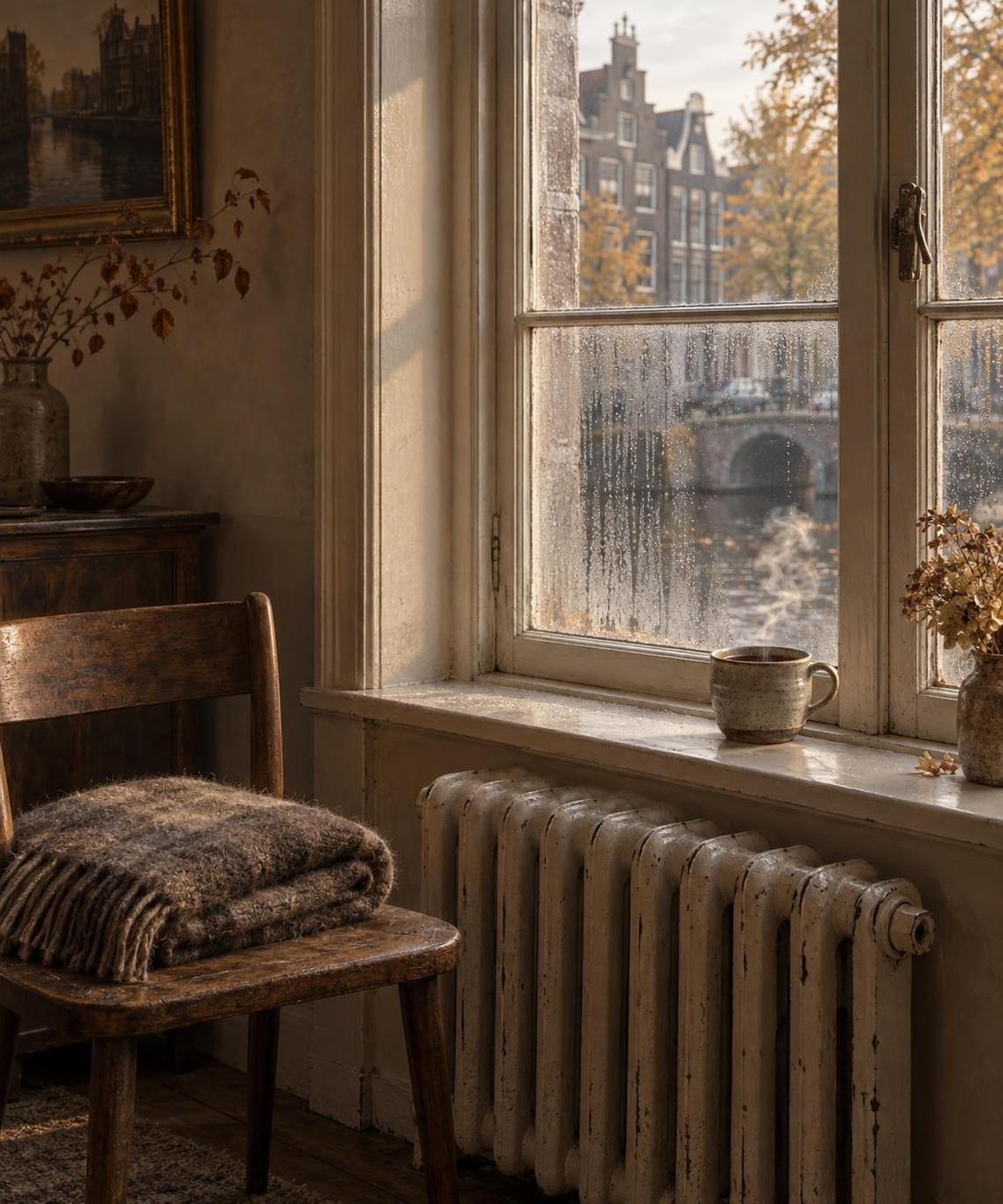
Somewhere around five in the morning the radiator ticks once. It is not a warning and it is not a promise. It is the sound of a cold system beginning to remember what it is for. Water has moved through a pipe that was empty for four months; a bracket has expanded by the width of a hair; a small metallic complaint has crossed the room and reached the pillow before the light does. One learns, after enough winters in a Dutch house, to hear that sound with something like affection. It is the first honest word the year has spoken since August.
The thermostat, of course, was set weeks ago. The forecast said what it always says in September, in the neutral voice of an institution that does not itself feel cold. But a forecast is not weather; a schedule is not a season; and no line on a screen prepares you for the specific hour in which the house declares that it can no longer keep pretending. The radiator ticks, and the pretending stops. That is worth more than most public announcements this month.
A cast-iron radiator has the great domestic virtue of being slow. It does not deliver heat the way a fan does, in a rush and then a lie. It gathers itself for an hour, warms its own ribs first, then warms the air near its ribs, then warms the coat left on the chair beside it, and eventually — with an old Flemish patience — warms the room. By the time it succeeds, the person who set it running has already left for the market. This is not inefficiency. This is the correct relation between a machine and a morning: it works while you are elsewhere, and it is ready when you return.
I have grown suspicious, in recent years, of systems that promise instant warmth. Nothing worth having in a house arrives instantly. Bread does not; broth does not; sleep does not; friendship does not; grief certainly does not. A radiator that takes an hour to warm a room is teaching a small daily lesson about pacing which most of contemporary life is arranged, at considerable expense, to unteach. The tick before dawn is the opening note of a slow score, not a click of a switch.
There is also the small, unfashionable pleasure of putting the hand on the pipe an hour later and finding it warm. Not hot — warm; the temperature of a body, a bread crust, an animal in the sun. One stands there in a wool sweater and socks, kettle boiling in the next room, the linen curtain moving in a way it has not moved since June, and the world outside is doing whatever the world outside is doing. It is not a moment that generates content. That is precisely the point. A house that ticks quietly to itself in the dark is a house that has, for a few hours, escaped the tyranny of the notification.
The radiator also marks a rearrangement of the household body. The chair migrates six inches closer. The blanket comes down from the cupboard, folded once and left on the arm, ready. A pair of thicker socks moves from the drawer to the shoe rack. A second cup appears on the sill because tea is drunk earlier now, and it is drunk hotter. None of this is decided at a meeting. It is decided by the metal.
Let the radiator tick, then. Do not turn on every room at once. Do not shame the machine for being slow. Sit near the warmest pipe with a book you have already read, and let the house do what a house does in the last week of September, which is to remember its winter self quietly, without ceremony, and one degree at a time. If the year is going to end, one may as well be in the room with the small instrument that is honest enough to say so.