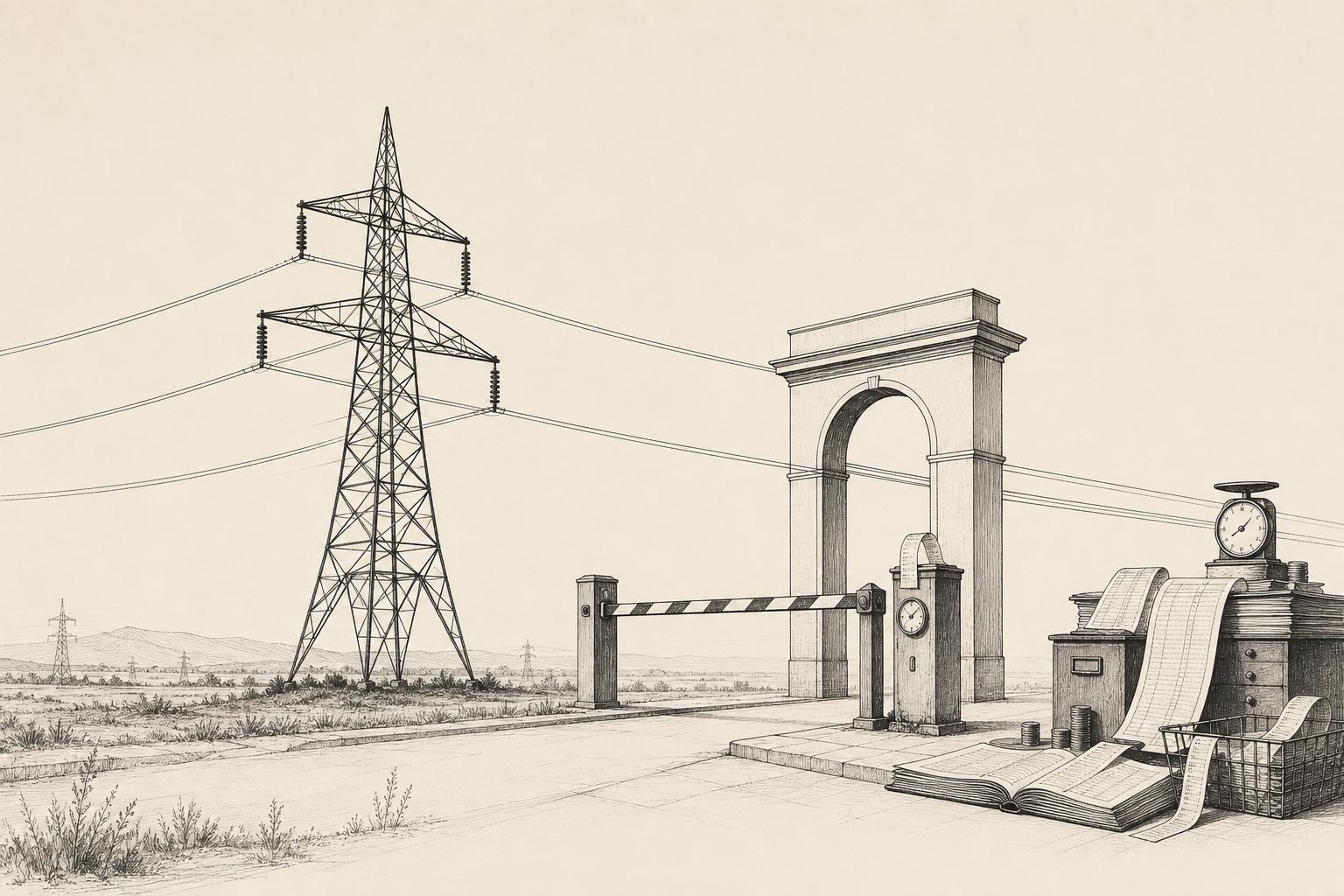
Europe now says the word electrification with priestly confidence. Heat pumps, electric vehicles, data centres, industrial process heat, AI infrastructure: the future, we are told, runs on clean power.
Fine. Then electricity should become the cheap backbone of European life.
Instead, we have built a system in which electricity often arrives as a premium product. The European Commission’s own language is quietly humiliating: energy poverty affects more than 46 million Europeans, and electricity is about three times more expensive than gas in many European countries.[1] That is not a minor retail irritation. It is a policy confession.
A continent that wants people to leave fossil fuels behind but makes the cleaner carrier dearer is not leading a transition. It is staging one.
The Public Story Is Too Polite
The polite version of the problem is that energy is expensive because the world is turbulent, Europe imports fuel, and decarbonisation costs money. All true in part. Also incomplete in the useful way bureaucratic truths tend to be incomplete.
The sharper version is this: Europe does not merely suffer high electricity prices. It actively preserves them through design.
Mario Draghi put the matter more bluntly than most governments dare. Even after the crisis peak, EU companies still face electricity prices two to three times those in the United States, while natural gas prices are four to five times higher.[2] He adds an uglier detail: the price gap is not only about natural resources, but also about “fundamental issues with our common energy market”. Market rules, he notes, prevent industry and households from capturing the full benefits of clean energy, while high taxes and rents captured by financial traders raise costs across the economy.[2]
There it is. Not nature. Not fate. Design.
Europe likes to speak about the transition as if it were mainly a moral effort. In practice it is also a tariff question, a grid question, a contract question, and a state-capacity question. This is less romantic, which is precisely why it matters.
We Tax the Carrier We Need Most
The deepest absurdity is not even industrial. It is conceptual. We keep saying electricity should displace combustion across transport, heating, and production. Yet we still treat electricity bills as a convenient mule on which to pile taxes, levies, network costs, and assorted policy debris.
Eurostat’s latest figures show that, for household consumers across the EU, taxes made up 27.6% of the electricity price in the first half of 2025.[3] The Commission’s own Affordable Energy page now says openly that member states could lower bills through lower taxation of electricity, by removing non-energy cost components from bills, and by making network charges more efficient.[1] One does not write this unless the disease is already obvious.
It becomes more ridiculous when viewed through electrification itself. If electricity remains expensive relative to gas, every sermon about heat pumps and industrial electrification becomes structurally dishonest. We are asking households and firms to adopt the future on a price signal inherited from the past.
That is not transition policy. It is moral theatre with a utility bill attached.
This Is Not One Market
Europe also flatters itself with the phrase single market. In electricity, this often means a continent speaking in the singular while billing in the plural.
Eurostat’s 2025 numbers are an elegant insult to the myth of coherence. For households, electricity prices in the first half of 2025 were €0.3835 per kWh in Germany and €0.3571 in Belgium, while Hungary stood at €0.1040 and Bulgaria at €0.1300.[3] For non-household consumers, prices ranged from €0.2726 per kWh in Ireland to €0.0804 in Finland.[3]
Such spreads are not the sign of a machine working beautifully. They are the sign of an incomplete union built atop different tax regimes, infrastructure bottlenecks, political reflexes, and energy mixes. Again the Commission now says so almost explicitly: a genuine Energy Union, with stronger coordination and a fully integrated market, is needed to avoid system costs rising by as much as €103 billion by 2040.[1]
In other words, Europe still pays a continental premium for national half-seriousness.
The Industrial Cost Is Already Visible
This is not an abstract complaint from people who enjoy comparing charts in Brussels hotels. It is already rearranging production.
Draghi notes that around half of European companies see energy costs as a major impediment to investment, roughly 30 percentage points more than American companies.[2] Energy-intensive industries have been hit hardest: production is down 10–15% since 2021, while imports from places with lower energy costs rise accordingly.[2]
The vulgar truth is that industry does not care how poetic your decarbonisation rhetoric sounds. It cares whether the meter makes expansion rational. If power remains structurally expensive and structurally uncertain, Europe will continue to keep the speeches and lose the load.
Serious Asian states understand this better. They do not treat cheap power as an environmental side issue, an industrial side issue, or a digital side issue. They treat it as all three at once. Europe is still arguing over departmental ownership while the bill arrives.
What Would Adult Policy Look Like?
First, electricity should become the energy carrier we deliberately make cheapest. Not by fantasy, but by structure. Lower the taxes on electricity. Strip non-energy policy costs off the bill where possible. Stop using the power invoice as a Christmas tree for every public objective too cowardly to finance elsewhere.
Second, accelerate the dull machinery: permitting, grids, substations, storage, flexible demand, and cross-border interconnection. The Commission is right to stress long-term electricity supply contracts, faster permitting, reinforced grids, and flexibility.[1] Cheap clean generation is not enough if it cannot travel, connect, or be contracted sensibly.
Third, give European industry durable access to long-term power prices it can plan around. PPA structures, contracts for difference where suitable, and disciplined public-private agreements are vastly less glamorous than summit slogans, which is exactly why they have a chance of working.
Fourth, stop confusing emergency relief with reform. Sending compensation after the bill lands may be socially necessary in crises. It is not a substitute for redesigning the bill itself.
The Choice
Europe can keep talking about electrification as a civilizational mission while preserving a retail and industrial structure that punishes it. That is the current model. It produces fine speeches, irritated households, hesitant factories, and a lingering sense that the future is something one is invited to applaud rather than afford.
Or Europe can decide that electricity is not a luxury line item but strategic ground: the wire on which industry, heating, mobility, and digital capacity now all depend.
A continent that taxes the wire will not electrify with conviction. It will import the future from places that understood, in time, that abundance begins at the meter.
Sources
[1] European Commission, Affordable energy (page accessed 2 May 2026): energy poverty affects more than 46 million Europeans; electricity is about 3 times more expensive than gas in many European countries; the Affordable Energy Action Plan calls for lowering taxation of electricity, removing non-energy cost components from bills, more efficient network charges, long-term electricity contracts, faster permitting, stronger grids and flexibility; a genuine Energy Union could avoid system costs of up to €103 billion by 2040.
https://energy.ec.europa.eu/strategy/affordable-energy_en
[2] European Commission / Mario Draghi, The future of European competitiveness: A competitiveness strategy for Europe (Part A, September 2024): EU companies still face electricity prices 2–3 times those in the US and natural gas prices 4–5 times higher; high taxes and market design issues prevent households and firms from capturing the full benefits of clean energy; around half of European companies see energy costs as a major impediment to investment; energy-intensive industrial production has fallen 10–15% since 2021.
https://commission.europa.eu/document/download/97e481fd-2dc3-412d-be4c-f152a8232961_en?filename=The%20future%20of%20European%20competitiveness%20_%20A%20competitiveness%20strategy%20for%20Europe.pdf
[3] Eurostat, Electricity price statistics (data extracted October 2025; page updated 30 April 2026): household electricity prices in the first half of 2025 were highest in Germany and Belgium; the EU household average was €0.2872 per kWh; taxes made up 27.6% of the household electricity price; non-household prices rose by 0.9% year on year and ranged from €0.2726 per kWh in Ireland to €0.0804 in Finland.
https://ec.europa.eu/eurostat/statistics-explained/index.php?title=Electricity_price_statistics