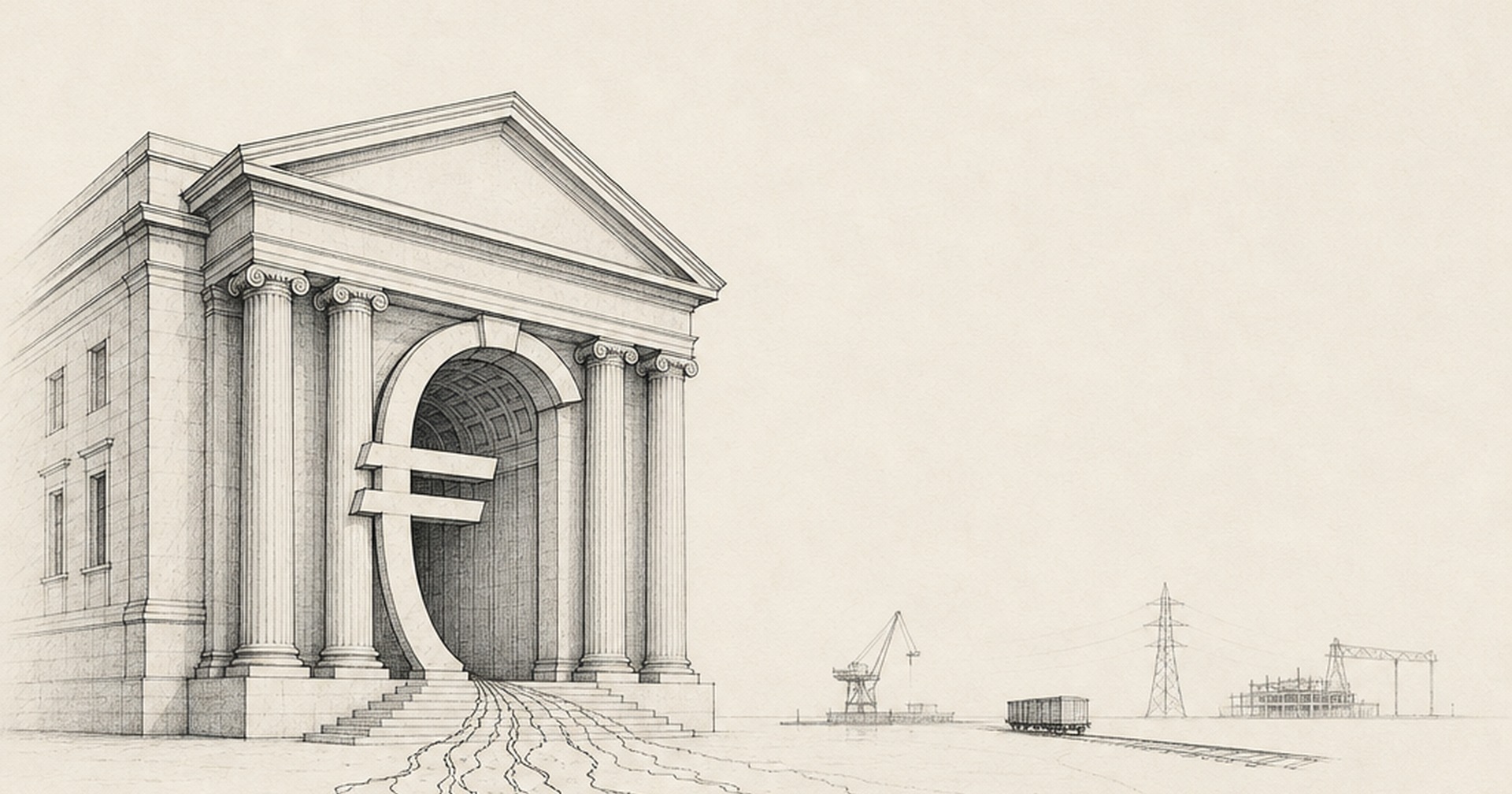
The usual complaint about Europe is that it has become timid, over-regulated, and strategically dependent. All true enough, as far as dinner-party diagnosis goes. But the deeper embarrassment is more precise. Europe still has money. What it lacks is command over money.
According to World Bank data, the European Union saved 24.7% of GDP in 2024. The United States saved 17.8%. China saved 42.8%. So no, the continent is not destitute. Yet the same dataset shows EU gross capital formation at 21.6% of GDP, below China’s 40.6% and fractionally below the United States at 21.8%. America invests more than it saves because the dollar system can attract the difference. China invests almost everything it saves because the state, the banks, and the industrial machine still know how to obey one another. Europe sits awkwardly between the two: rich enough to save like a power, too fragmented to invest like one.
That is the real strategic problem hiding beneath the usual chatter about competitiveness. In a world of tariff threats, export controls, expensive energy, and insecure sea lanes, capital-market design is no longer a polite finance topic for men in mauve ties. It is a question of whether a civilisation can convert its own surplus into physical systems before events do the conversion for it at a much uglier price.
The continent is not short of needs. It is short of alignment.
The European Commission has now admitted the scale of the gap in unusually plain language. Its new Savings and Investments Union says Europe faces additional investment needs of roughly €750-800 billion per year by 2030, a number drawn from Mario Draghi’s competitiveness report and now made even less comfortable by higher defence demands. Much of that need concerns smaller firms, innovators, infrastructure, and other things that do not fit neatly inside the old bank-loan model. Brussels is correct on the diagnosis. If Europe wants grids, compute, industrial capacity, cleaner transport, munitions output, and the rest of the serious twentieth-century furniture now returning to fashion, it cannot finance the whole bill with nostalgia and public speeches.
What makes the situation peculiarly European is that the money exists, but the channels behave like a federation that never quite trusted itself. The Commission’s own language is revealing: fragmentation, divergent supervisory practice, excessive red tape, burdensome reporting, barriers to cross-border capital movements. One reads the list and imagines a continent trying to build a power corridor while tripping over its own filing cabinets.
This is why so many European arguments about de-risking feel cosmetically tough while materially thin. Politicians announce new urgency on China, semiconductors, defence production, batteries, cloud capacity, or grid modernisation. Fine. But a tariff is not a transformer. A press conference is not a dredged port. An industrial strategy is not yet an investable project pipeline. Before sovereignty appears in steel or copper, it must first appear in term sheets, guarantees, supervision, pension mandates, and the boring legal machinery that lets capital cross a border without fainting.
China commands savings. America absorbs the world’s.
The world-system comparison is brutal. China’s advantage is not merely that it manufactures a great many things. Its deeper advantage is that it has retained a civilisation-scale habit of forcing domestic savings into plant, logistics, energy, housing, and industrial stock, sometimes too crudely, often wastefully, but always with unmistakable force. Forty-odd percent of GDP invested year after year is not an accident of temperament. It is an institutional capacity.
The American system works differently. It does not need to save first in order to move. It issues the reserve currency, offers the deepest capital markets on earth, and runs an apparatus in which deficits, venture finance, defence procurement, and market liquidity reinforce one another. This is why the United States can invest more than it saves without immediately looking ridiculous. The gap is not a bug in the imperial software. It is part of the product.
Europe enjoys neither privilege in full. It does not possess Beijing’s command structure, and it does not possess Washington’s financial gravity. It has large household wealth, major banks, insurers, pension pools, engineering competence, excellent ports, and still-formidable industrial clusters. But these assets do not automatically compose themselves into continental power. Too often they remain national, defensive, under-coordinated, or simply too polite. Europe keeps treating capital as something that should be gently encouraged. The age now arriving will favour systems that can instruct it.
The second-order effect is a sovereignty premium
This is the overlooked consequence of the new world economy. Europe will not merely pay more for energy, hardware, and security because the old global bargain is fraying. It will also pay a sovereignty premium because it has to buy resilience from systems that finance and coordinate faster than it does. That premium hides everywhere: in slower grid build-out, in venture scale that migrates elsewhere, in defence lines that cannot expand quickly, in ports and rail links that become planning theatre, in the queue for transformers, cables, fabs, or data-centre power.
The vulgar debate asks whether Europe should de-risk from China. Of course it should reduce dangerous concentrations. The more interesting question is whether it can finance the alternative at continental scale without turning every resilience project into a boutique exception. If not, de-risking becomes a luxury tax the continent levies on itself. It will still import dependency, only now at a higher moral pitch and a worse margin.
This is why the Commission’s Savings and Investments Union matters more than its bureaucratic title suggests. It should not be understood as a nice reform for savers, nor as a tidying exercise for financial lawyers. It is an attempt — late, partial, but necessary — to answer the geopolitical question beneath the financial one: can Europe make its own capital stay long enough to build its own future?
Command is not a metaphor
Three things follow.
First, Europe has to treat capital-market integration as hard infrastructure policy, not as a side chapel of single-market piety. If a strategic project cannot be financed across borders with routine confidence, then Europe does not yet have a continental market in any meaningful strategic sense.
Second, it needs a real pipeline of standardised projects: grids, interconnectors, ports, compute, industrial retrofits, defence capacity, freight corridors. Investors do not fund slogans. They fund structures with permits, offtake, governance, and legal clarity. The continent has spent too long discussing ambition in the abstract while neglecting the engineering of investability.
Third, Europe has to become less squeamish about directing long-term savings. Not confiscating them, not nationalising everything in sight like some museum piece from 1974, but building institutions that can channel retirement money, insurance balance sheets, and household capital into continental build-out without turning the process into a pilgrimage through twenty-seven administrative temperaments.
Money is not sovereignty. But sovereignty without money under discipline is theatre. The next order will be less forgiving of rich societies that can save, analyse, regulate, and convene, yet still fail to build. Europe’s problem is no longer that it lacks insight into the world. It lacks enough force over its own surplus.
In the coming decade, capital that cannot be commanded at home will end up serving someone else’s empire.
Sources
European Commission, Savings and investments union — policy page setting out the aim of linking savings to productive investment, the additional investment need of €750-800 billion per year by 2030, and the connection to geopolitical, technological, climate, and defence pressures.
https://finance.ec.europa.eu/regulation-and-supervision/savings-and-investments-union_en
European Commission, Savings and investments union strategy to enhance financial opportunities for EU citizens and businesses, plus the SIU factsheet and barriers page — used for the Commission’s framing of fragmentation, integration barriers, and the need to connect savings with productive investment.
https://finance.ec.europa.eu/publications/savings-and-investments-union-strategy-enhance-financial-opportunities-eu-citizens-and-businesses_en
https://finance.ec.europa.eu/regulation-and-supervision/savings-and-investments-union/factsheet-savings-and-investments-union_en
https://finance.ec.europa.eu/regulation-and-supervision/savings-and-investments-union/barriers-financial-market-integration_en
European Commission, The Draghi report on EU competitiveness — background page for Draghi’s competitiveness diagnosis and the Commission’s subsequent use of it in the competitiveness compass and related policy agenda.
https://commission.europa.eu/topics/competitiveness/draghi-report_en
World Bank Open Data API — gross savings (% of GDP) and gross capital formation (% of GDP) for the European Union, China, and the United States; 2024 values used in the opening argument and rounded to one decimal place.
https://api.worldbank.org/v2/country/EUU;CHN;USA/indicator/NY.GNS.ICTR.ZS?format=json&per_page=20
https://api.worldbank.org/v2/country/EUU;CHN;USA/indicator/NE.GDI.TOTL.ZS?format=json&per_page=20