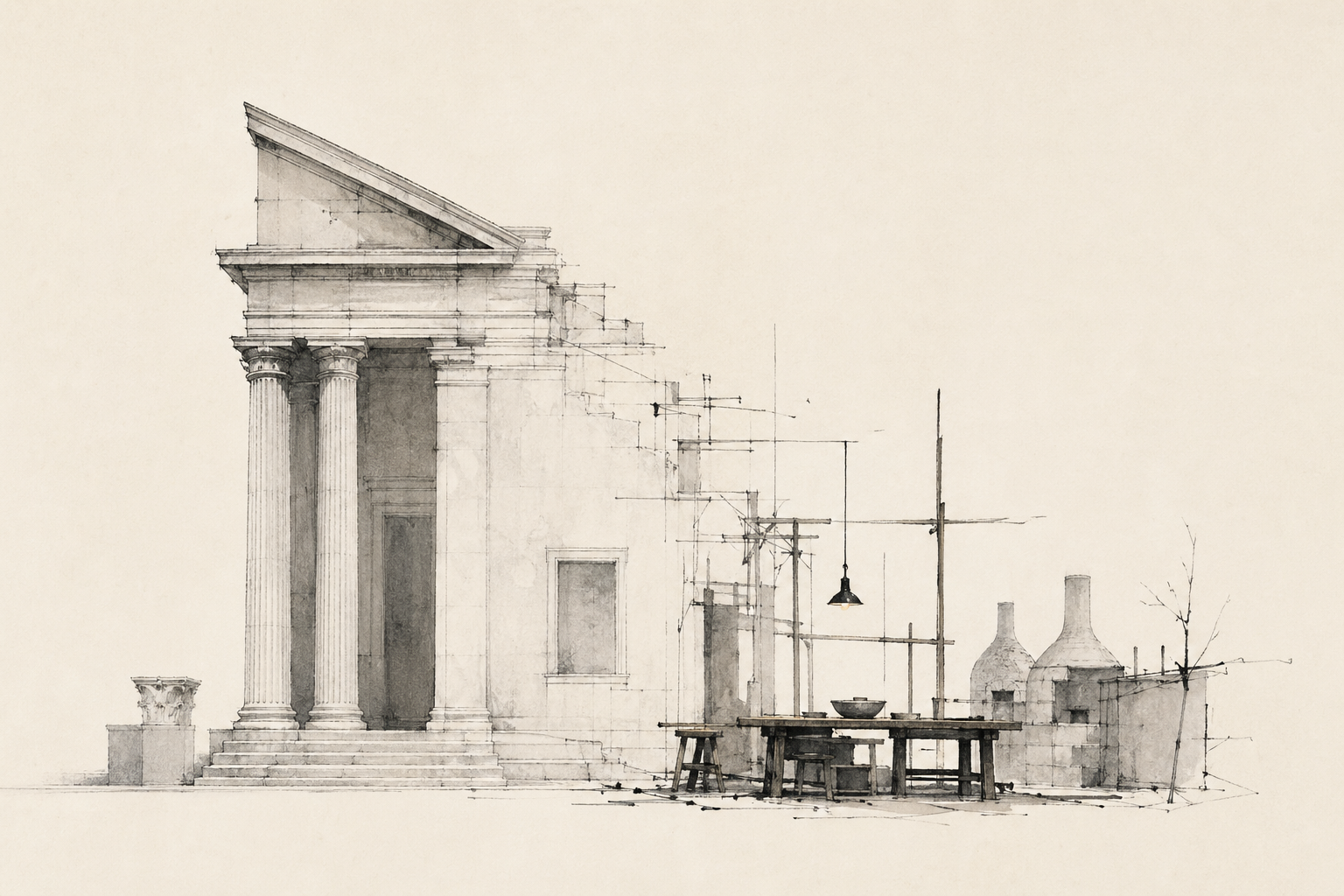
Europe does not lack culture. It lacks confidence in living culture.
We preserve, catalogue, restore, exhibit, commemorate. We are much less willing to provide the duller things without which culture is actually made: space, time, tools, storage, technical support, tolerable rent, and the right to fail without instant financial execution.
That is not a minor policy imbalance. It is a civilizational tell. A society that funds memory more easily than making is quietly confessing that it trusts the past more than the future.
None of this is an argument against museums. Only an idiot declares war on memory. Collections must be preserved. Buildings must be maintained. Scores, archives, churches, objects, and paintings must be cared for. A civilization without an archive becomes hysterical, fashionable, and stupid.
The problem is not preservation itself. The problem is that preservation has become institutionally safer than production.
That would already be ugly on cultural grounds. It is even uglier when one looks at the scale involved. According to Eurostat, the EU counted roughly 7.9 million people in cultural employment in 2024, or 3.8% of total employment. In 2023 there were around 2.1 million cultural enterprises, together generating roughly €202 billion in value added.[1][2] This is not a boutique hobby sector for tasteful weekend people. It is a serious economic field.
Yet much of Europe still behaves as if culture exists primarily to be shown nicely, not made under difficult conditions. That is the scandal.
The Real Scarcity Is Space
We like talking about subsidy totals because money is abstract and abstraction is polite. But makers rarely die of abstraction. They die of rent, zoning, missing square meters, absent workbenches, kilns, rehearsal rooms, storage, and long-term access.
The dead artist asks for nothing. He requires no noisy room, no ventilation, no key, no insurance for machinery, no awkward conversation about whether the work is ready. He arrives as prestige.
The living maker arrives as an inconvenience. He asks for infrastructure.
That is why so many institutions prefer openings to workshops, public programming to long discipline, visibility to production. The event photographs better than the years required to make the thing worth photographing.
The labor structure tells the same story. In 2024, 31.7% of cultural workers in the EU were self-employed, compared with 13.6% in the wider economy. Among artists, writers, journalists, and linguists, the share rose to 45.1%. In the Netherlands, cultural work accounts for 5.3% of total employment and 46.0% of cultural workers are freelancers. [1]
A sector built on that degree of precarity does not first need more flattering rhetoric. It needs conditions in which people can keep working.
The Museum Defeats the Workshop
The central question is therefore not whether Europe spends enough on culture in the abstract. The sharper question is this: under what physical conditions is new culture allowed to come into being?
A studio is not a romantic accessory. A workshop is not an amusing side room. A rehearsal space is not a subsidy ornament. These are forms of civilizational infrastructure.
They are where taste is corrected by material, where apprenticeship becomes real, where form survives the encounter with resistance. Once that infrastructure disappears, culture is easily replaced by curation, mediation, branding, and institutional self-explanation.
Then one gets a distinctly European tragedy: a continent that adores its inheritance while slowly eating the conditions for new quality.
This is also why the argument reaches beyond the arts. The society that neglects workshops usually neglects other unfashionable things as well: industry, maintenance, technical education, energy security, craft, and public space. The pattern is always the same. We want the façade, but not the scaffolding.
We praise design while letting the conditions of making disappear. We celebrate creativity while pricing out the spaces in which skill is formed. Then we act surprised when culture becomes thin, theoretical, or aristocratic in the bad sense: managed by interpreters, detached from production.
No Public Conservation Without Public Production
The demand, then, should be institutional rather than sentimental. Not vague sympathy for living artists, but a hard obligation.
Whoever receives public money to preserve culture should also be required to make room for new culture to be made.
Large publicly funded museums, kunsthalles, and heritage institutions should be judged not only on collections, attendance, education, and visibility, but also on their concrete contribution to production.
Not symbolically. Not with a broom closet renamed a makers lab. Materially: workspace, duration, technical support, and conditions under which real work can happen.
The question should not only be how many visitors an institution attracted or how elegantly it restored an object. It should also be how many makers were able to work there, under what terms, and what new work would simply not have existed without that support.
The Conservator’s Objection
The predictable response is that this attacks museums and heritage. It does not. A civilization needs palaces of memory. Only a barbarian destroys the archive.
But there is a difference between memory and fixation. When too much cultural legitimacy revolves around management, presentation, governance, and the endless reproduction of inherited prestige, cultural policy turns into necrology with climate control.
That matters because the sums are real. Eurostat calculated €81.1 billion in government expenditure on cultural services in the EU in 2023, or roughly 1.0% of total government spending and 0.5% of GDP. [3] If public money can preserve greatness, it can also be required to seed the conditions for future greatness.
What Should Change
First, funding criteria should explicitly reward living production: time, space, tools, and affordable access, not just management and audience metrics.
Second, cities must protect productive space. In expensive cities, workshops almost always lose to real estate unless policy takes a side. Zoning, leasehold structures, low-rent zones, co-operatives, and long guarantees are not decorative details. They are the whole game.
Third, Europe should restore the chain of apprentice, master, and craft. Not everything worthwhile passes through an art academy and a PDF application form. Skills need places, tools, repetition, and transmission.
Fourth, institutions should be measured by what they help produce. How much work becomes possible there? How many hours, meters, machines, and forms of guidance are made available? Those are the adult questions.
The Deeper Question
Beneath the policy argument lies a harsher suspicion: perhaps Europe subsidizes its dead not only out of habit, but out of disbelief. Perhaps it no longer quite believes that anything new can emerge worthy of the civilization whose remnants it so expertly stages.
That is the real melancholy here. Not love of history, but lack of confidence in posterity. Too many institutions treat the past not as inheritance to extend, but as shelter from the risk of making.
That attitude deserves to disappear. Europe does not need to become younger, louder, or more innovative in the vulgar sense. It needs to become productive again.
A civilization that celebrates its dead while denying its living room to work is not honouring culture. It is embalming itself.
Sources
[1] Eurostat, Culture statistics – cultural employment
(data extracted May 2025): 7.9 million cultural workers in the EU
in 2024; 3.8% of total employment; 31.7% self-employed in culture;
45.1% self-employed among artists/writers/journalists/linguists;
the Netherlands at 5.3% cultural employment and 46.0%
self-employment in culture.
https://ec.europa.eu/eurostat/statistics-explained/index.php?title=Culture_statistics_-_cultural_employment
[2] Eurostat, Culture statistics – cultural enterprises
(data extracted December 2025): 2.1 million cultural enterprises in
the EU in 2023; approximately €202 billion in value added; 6.4% of
all enterprises in the business economy.
https://ec.europa.eu/eurostat/statistics-explained/index.php?title=Culture_statistics_-_cultural_enterprises
[3] Eurostat, Government expenditure on cultural, broadcasting
and publishing services (data extracted March 2025): €81.1
billion in government expenditure on cultural services in the EU in
2023; 1.0% of total government expenditure; 0.5% of GDP.
https://ec.europa.eu/eurostat/statistics-explained/index.php?title=Government_expenditure_on_cultural,_broadcasting_and_publishing_services