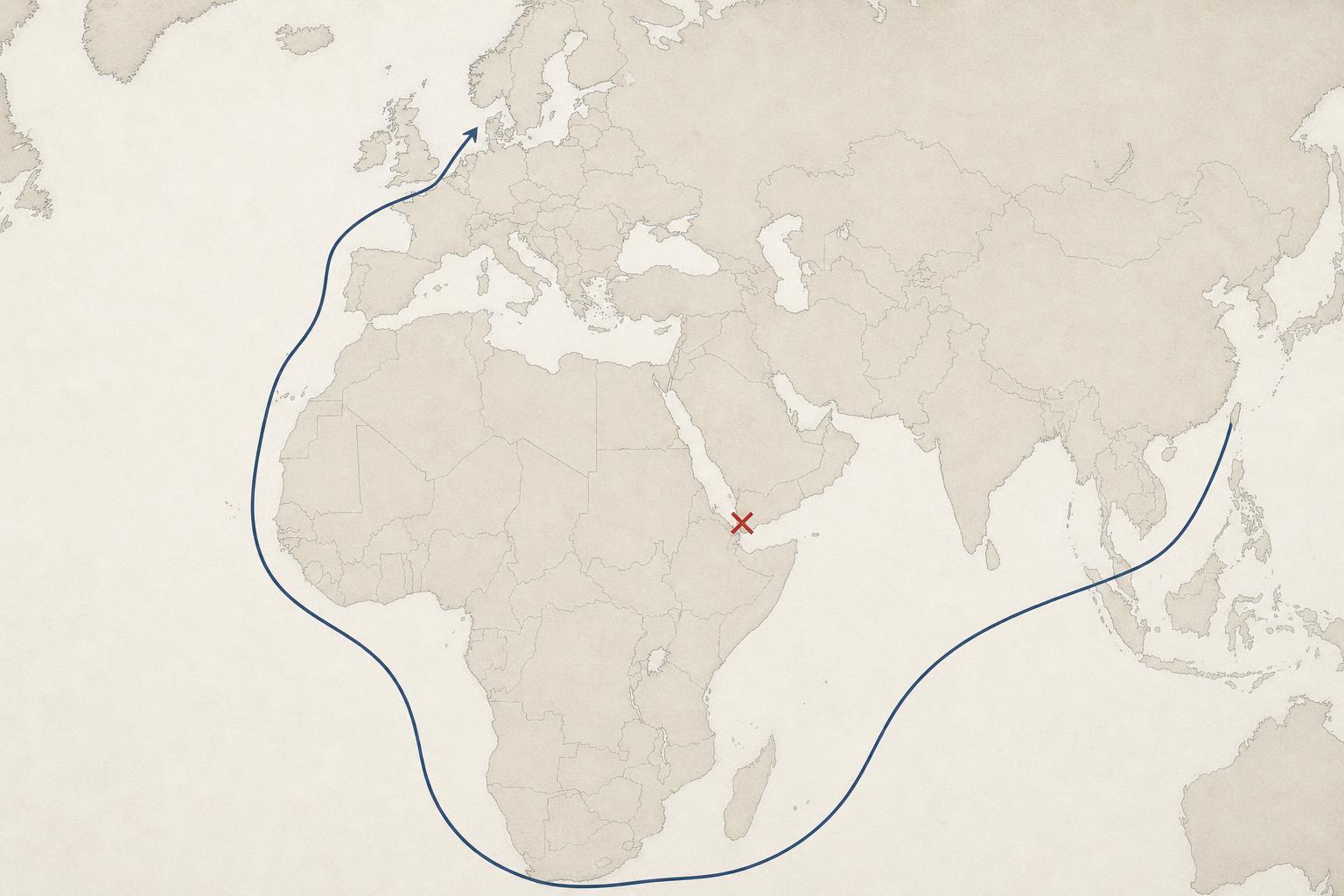
The public language of trade remains absurdly bureaucratic for a subject so physical. We still talk as if commerce moved mainly by spreadsheet, with ministers adjusting tariffs at one end and central bankers soothing inflation at the other. Very elegant. Very post-historical. Then a few militants, a nervous insurance market, and one vulnerable corridor in the Red Sea remind everyone that trade still moves by hull, crew, fuel, canal slot, and sea lane.
This is the real meaning of the Red Sea disruption: it has turned geography back into a tariff. Not a tariff in the legal sense, of course. No customs officer stamps it. No finance minister announces it at a podium. But the effect is the same. When ships that would have crossed the Suez Canal are forced around the Cape of Good Hope, distance begins charging rent. Fuel, wages, charter time, insurance, working capital, schedule reliability, vessel rotation, inventory risk — all rise together because the sea has become longer.
The numbers are indecently clear. UN Trade and Development notes that by mid-2024 tonnage crossing the Gulf of Aden had fallen 76% and tonnage transiting the Suez Canal 70%, while arrivals around the Cape of Good Hope surged 89%. Longer routes pushed global vessel ton-mile demand up 3% and container ship demand up 12%. For a large Far East-Europe container vessel, the extra carbon bill alone can add roughly $400,000 under the EU’s emissions trading system. If elevated freight rates persist, UNCTAD projected, they feed directly into consumer prices. That is what a geography tariff looks like in civilian life: not merely delay, but inflation with saltwater on it.
And this is not merely a 2024 story embalmed in a report. Recent reporting from Reuters, Seatrade Maritime News, Journal of Commerce, and Lloyd’s List shows the same logic still governing decisions in real time. Carriers that had flirted with returning to Suez have again suspended or reversed those plans, sending services back around the Cape. The new anxiety around the Strait of Hormuz only sharpens the point: once one chokepoint becomes doubtful, the market starts repricing the whole corridor system around it.
The Winner Is Whoever Owns Slack
The under-discussed consequence is concentration. When routes lengthen, the winners are not simply the cheapest producers or the cleverest diplomats. They are the actors with spare hulls, deeper balance sheets, better port throughput, and enough scheduling slack to absorb longer rotations without disintegrating. Disorder at sea behaves like a selective pressure. It rewards industrial depth.
That is why this episode matters beyond the Red Sea itself. The world shipping system was already highly concentrated before the missiles began flying. Asia handles more than 63% of global container port traffic. Global shipbuilding is even more concentrated: according to UNCTAD, China, Japan, and South Korea accounted for 95% of world shipbuilding output in 2023, with China delivering more than half the world’s capacity for the first time. The point is not merely that Asia manufactures many things. It is that Asia increasingly manufactures the machinery of circulation itself.
Once you see that, the hierarchy looks different. A tariff is annoying. A sanctions package can be evaded. A maritime chokepoint crisis, by contrast, redistributes power toward whoever owns yards, berths, feeders, dry docks, containers, routing discipline, and the patience to think in nautical miles rather than election cycles. The old world-system question returns in its simplest form: who controls the means by which goods physically move?
Europe Wants Green Trade Without Maritime Power
Europe’s position in this arrangement is more embarrassing than most of its officials care to admit. Brussels likes the phrase strategic autonomy. It rolls off the tongue beautifully, like a phrase rehearsed for a conference badge. But on maritime trade the continent’s reality is much cruder. Since January 2024 the EU ETS has covered all large ships entering EU ports, including 50% of emissions from voyages starting or ending outside the Union and 100% of emissions between EU ports and in-port activity. In plain language: Europe now taxes part of the detour around Africa while lacking control over the shipping geography that made the detour necessary.
This is a very European arrangement. Moral seriousness at the point of accounting; dependency everywhere else. The continent wants decarbonised logistics, resilient supply chains, strategic de-risking from China, and cheap imported industrial inputs, all at once, while treating merchant marine capacity, ship finance, port technology, dredging, and naval escort as faintly vulgar subjects better left to other people. One can call that a strategy if one has been over-served at the policy buffet. In harder language, it is outsourcing with incense.
The second-order effect is the important one. Every maritime shock now lands twice on Europe: first as a transport disruption, then as a political contradiction. The longer the route, the more the continent pays for the carbon of dependency, the more exposed its inflation path becomes, and the more absurd its industrial rhetoric sounds. You cannot decarbonise a trade system whose security and vessel base you do not meaningfully command.
Even America Has Finally Noticed
Washington, in its usual brass-band style, has at least managed one useful confession. On its 2026 maritime policy page, the White House states that less than 1% of new commercial ships are built in the United States and that the country has only 66 shipyards in total. One can argue about the tone of the performance. The underlying admission is sound. Shipbuilding is not a nostalgic side industry. It is state capacity with steel ribs.
That matters because the next phase of trade politics will not be decided only by who can write a tougher tariff schedule. It will be decided by who can shorten routes, secure routes, substitute routes, or survive longer routes without hollowing out domestic legitimacy. The unit of competition is shifting from nominal efficiency to resilience per nautical mile.
Lloyd’s List recently reported that roughly 170 containerships with a combined capacity of about 450,000 teu were stuck inside Hormuz under movement restrictions — roughly 1.4% of the global fleet. Seatrade and Journal of Commerce likewise reported Maersk, Hapag-Lloyd, CMA CGM, and MSC pulling back from Trans-Suez plans and re-routing via the Cape. That is how chokepoint risk behaves in practice: it cascades. The map does not politely wait for policymakers to finish their panel discussion.
The New Politics Will Be Geographic Again
Expect three consequences. First, regionalisation will keep advancing, not because globalisation is ending in some melodramatic sense, but because distance has become more visibly priced. Firms and states will pay more for shorter circuits when the alternative is strategic exposure disguised as cheapness. Second, shipyards, ports, inland terminals, and shipping finance will return as strategic sectors rather than background plumbing. Third, the divide between countries that can still do material coordination and those that can only regulate outcomes from a lectern will widen.
Europe is in danger of ending up on the wrong side of that divide. It still has first-rate ports, insurers, technical expertise, and a large consumer market. But prestige is not capacity. If the continent wants serious de-risking, serious decarbonisation, or serious industrial policy, it must treat maritime infrastructure as part of sovereignty rather than as a low-status utility under the wallpaper. That means merchant shipping, port digitisation, corridors to hinterland industry, ship finance, and naval seriousness. Without those, the green transition remains a decorative policy genre — all aspiration, no keel.
The most revealing thing about the Red Sea episode is that it has made an old imperial fact visible to people who preferred abstractions. Trade is not governed first by slogans, nor by moral theater, nor by central-bank incantation. It is governed by distance, chokepoints, escorts, yards, and the industrial societies able to organise them.
The world order is being rewritten not only in summits and sanctions packages, but in how far a ship must sail when one strait becomes unusable. Right now the sea is writing the tariff schedule. Europe is still reading from last year’s brochure.
Sources
UN Trade and Development, Review of Maritime Transport 2024 — chokepoint disruption, route diversion, ton-mile demand, freight-rate and shipbuilding concentration data.
https://unctad.org/publication/review-maritime-transport-2024
European Commission, Reducing emissions from the shipping sector — scope and phase-in of maritime coverage under the EU Emissions Trading System.
https://climate.ec.europa.eu/eu-action/transport-decarbonisation/reducing-emissions-shipping-sector_en
The White House, Restoring America’s Maritime Dominance — current U.S. shipbuilding capacity, yard count, and official framing of maritime industrial weakness as a strategic problem.
https://www.whitehouse.gov/maritimemight/
Reuters, Maersk pauses sailings through Suez Canal/Bab el-Mandeb, citing escalating risk — live reporting on renewed carrier caution and route suspension amid regional escalation.
https://www.reuters.com/world/middle-east/maersk-pauses-sailings-through-suez-canal-bab-el-mandeb-strait-citing-escalating-2026-03-01/
Seatrade Maritime News, Shipping lines reroute from Red Sea avoiding Houthi threat — trade reporting on carriers abandoning planned returns to Suez, Cape diversions, Gulf-port exposure, and freight implications.
https://www.seatrade-maritime.com/containers/shipping-lines-reroute-from-red-sea-avoiding-houthi-threat
Journal of Commerce, Maersk, Hapag-Lloyd to reroute some March sailings away from Red Sea/Suez — trade confirmation that carriers reverted to Cape routing under renewed regional volatility.
https://www.joc.com/article/maersk-hapag-lloyd-to-reroute-some-march-sailings-away-from-red-seasuez-6177149
Lloyd’s List, Iran attacks prompt Red Sea rethink as box shipping exits Strait of Hormuz — trade analysis on coupled chokepoint risk, stranded containership capacity, and simultaneous Hormuz/Red Sea disruption.
https://www.lloydslist.com/LL1156478/Iran-attacks-prompt-Red-Sea-rethink-as-box-shipping-exits-Strait-of-Hormuz