For most of the specialty era — roughly 1995 to 2015 — the moral geography of coffee was simple. Arabica was the noble bean: temperamental, aromatic, grown at altitude in Central America, East Africa, and the Colombian Andes. Robusta was its lowland cousin: hardy, bitter, cheap, and best kept out of the cup one served to guests. Third-wave cafés in Berlin, Melbourne, Oslo, and Amsterdam sold this hierarchy as a taste creed. It was also, quietly, a class creed. Arabica was what educated people drank; robusta was what filled the tins on supermarket shelves for everyone else.
That hierarchy has been overturned by a combination of forces no roaster in Antwerp can talk its way out of. Arabica production has spent a decade absorbing the physical consequences of a warming planet. The 2021 frost in Brazil erased a substantial part of a single harvest, and successive droughts in the Cerrado and Minas Gerais have kept the world’s largest arabica producer under pressure ever since. Colombian yields have been chewed on by La Niña rains, Central America by rust and by land-use flight. The arabica belt sits, on average, higher and cooler and more marginal every year. That is not a taste problem. That is a temperature problem.
Vietnam becomes a coffee power
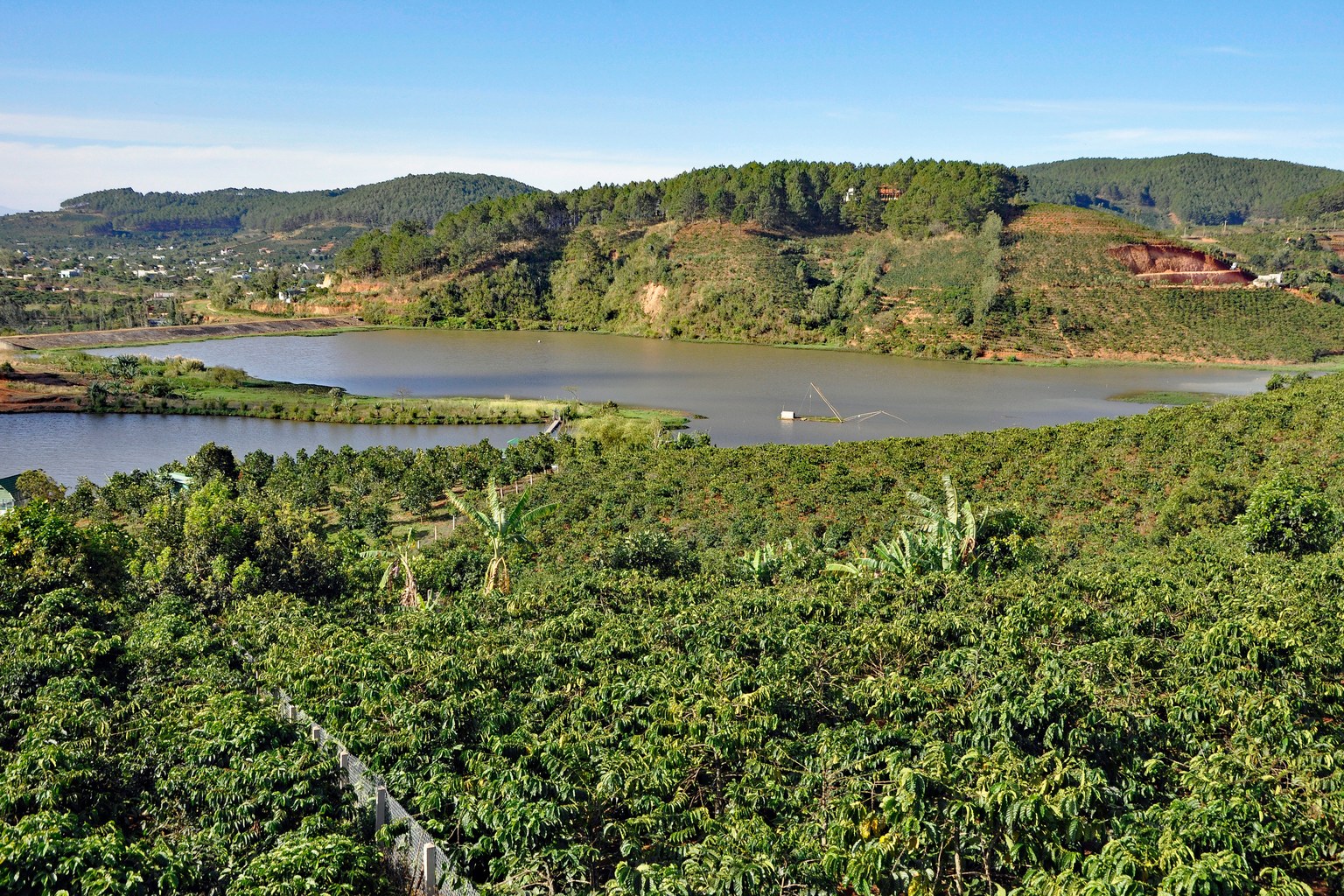
Robusta’s ascent has, meanwhile, a very concrete address. Đắk Lắk, Lâm Đồng, Gia Lai, Đắk Nông, Kon Tum: five Central Highlands provinces of a country that did not appear on the world’s serious coffee map until the 1990s. Vietnam is now the second-largest coffee producer on earth after Brazil, exports something on the order of 27 to 30 million 60-kilogram bags in a normal year, and supplies close to forty percent of the world’s robusta. In global terms, this is a top-tier commodity position achieved inside a single generation. It was made possible by state land allocation, hardy hybrids like the Robusta TR4 and TR9 lines, disciplined smallholder labour, and a domestic development strategy that treated coffee not as a lifestyle accessory but as a foreign-currency machine.
What Vietnam did with robusta is what Brazil did with arabica in the twentieth century. It industrialised a bean and then owned the price. The consequences are structural. When Vietnamese production stumbles — as it has in the last two crop cycles, hit by drought in the Highlands and by farmers pulling coffee bushes to plant more profitable durian and pepper — the whole world’s cup wobbles. London robusta futures broke through USD 5,000 per tonne in 2024 for the first time in the modern history of the contract, and stayed abnormally high through 2025. That is not a rounding error. That is a global rewiring.
The blend is where the war is fought
The taste creed of the specialty café was always a minority theatre. Most of the coffee drunk on earth is not pulled from a single-origin Ethiopian lot into a ceramic cup by a bearded man with a tattoo. It is sachet coffee, instant coffee, canned iced coffee, hotel coffee, office coffee, kiosk coffee, chain espresso, and supermarket blends. In that vast anonymous body of the market, arabica has never been the natural king; it has been a costly ingredient inside a blend that also contains robusta, chicory, caramel, or roasted rice. The war between the two beans has been fought there, invisibly, for decades. Robusta has been winning it for longer than the third wave admits.
Nestlé, which is the largest coffee company on earth and whose Nescafé brand alone drinks an outsized share of global soluble coffee, has spent years quietly reformulating and re-rationalising its bean mix under margin pressure. Big roasters do not send out communiqués when they nudge a Robusta share from 25 percent to 35 percent inside a soluble product. They simply do it, and the consumer, drinking a familiar sachet, tastes almost nothing. That is the actual story of the last two years. The world’s average industrial cup is browner, more caffeinated, and more Vietnamese than it was in 2019. Nobody had to convince anyone. The price did the convincing.
The bean the industry taught us to hate
There is a small comedy in all of this that ought to be enjoyed. For twenty years the specialty industry treated robusta the way certain Parisians treated the Belgian: politely, warily, from a distance. It was the wrong altitude, the wrong genetics, the wrong tannin. It gave you a headache. It ruined the crema. It was “filler”. It was the reason Italian espresso had that rough edge you were expected to grow out of once you moved to a nicer city.
Robusta’s revenge is not that suddenly it tastes wonderful. It does not, mostly. What has happened is more useful. A generation of Vietnamese, Ugandan, Indian, and Brazilian producers, with real capital behind them, has started to farm robusta seriously. Fine-robusta programs in Vietnam — wet-processed, altitude-planted, cup-scored by trained Q-graders under the Coffee Quality Institute’s protocol — are producing lots that clear 80 on the CQI scale and drink as clean, chocolate-heavy, low-acid coffees perfectly capable of holding their own in the cup. The point is not that fine robusta will replace great Ethiopian arabica. The point is that the moral wall between the two beans is coming down under economic pressure, and once a wall like that comes down, taste follows the money within a decade.
What the reordering actually means
Underneath the price story, three deeper shifts are working themselves out.
The first is climatic. Arabica’s optimum growing band is narrowing. The bean wants 18 to 22 degrees Celsius, cool nights, reliable rain, and a certain altitude. As tropical uplands warm and rainfall patterns become more erratic, the world’s arabica frontier is being pushed higher, colder, and further from the equator. Robusta, tolerant of heat and lower elevations, gets the ground arabica surrenders. Ethiopia and Colombia are already investing in higher-altitude arabica trials; Brazil is quietly expanding conilon (its own robusta variety) in Espírito Santo and Rondônia. This is not a policy trend. It is a species-fit trend.
The second is geopolitical. Coffee, like cocoa and palm oil, is a commodity in which a very small number of producing countries hold structural weight. Vietnam’s robusta dominance sits alongside Brazil’s arabica dominance the way Australia’s iron ore sits alongside Guinea’s bauxite: as a chokepoint that traders and roasters must learn by name. The European Union’s deforestation regulation, which now requires importers to prove that coffee (and other commodities) come from land not cleared after 2020, has laid a further compliance layer on top of that trade. Vietnamese smallholders, with fragmented plots and thin paperwork, are being pushed to formalise land data at a pace no equivalent European supply chain would tolerate. Whether the EU can hold the line, and at what cost, is one of the small tests of whether “green trade policy” means anything at all.
The third is anthropological, and it is the shift most European readers will feel first. The taste that a rich, ageing, health-conscious continent developed — light-roast arabica, single-origin, thin-bodied, aromatic — is not the taste of the world. Most humans drink coffee for caffeine, warmth, and social ritual, in that order. Robusta gives them roughly twice the caffeine per bean, at a lower price, in a form that survives soluble processing, iced canning, and sweet condensed milk without collapsing. From Ho Chi Minh City to Nairobi to São Paulo, the working cup of the twenty-first century looks a great deal more like a Vietnamese cà phê sữa đá than like a Nordic filter brew. That was already true a decade ago. It is now measurable in the trade data.
A last word from the counter
None of this is a case against arabica. A properly grown Yirgacheffe still opens like an unexpected flower in a small room, and no honest palate would give that up. But we should stop pretending that European tastes describe the world’s cup. They no longer do, if they ever did, and the last five years of price and climate data have said so with unusual clarity.
The bean the specialty industry taught us to look down on is now the bean holding up the retail shelf, the vending machine, the office kitchen, and much of the hot Asian street corner. Vietnam is quietly a coffee power. Robusta is quietly a serious crop. And the arabica-only worldview, like so many other minor European certainties of the late twentieth century, is being outgrown by a world that never asked for permission.
Drink well. Pay attention to what is in the cup. And be honest about the century you are actually living in.
Sources
International Coffee Organization, Coffee Market Report: monthly global trade and price series, including robusta and arabica differentials, world production, and exporter shares. Useful for the base numbers on Vietnamese share of world robusta and total global exports.
icocoffee.org / Coffee Market Report
United States Department of Agriculture, Foreign Agricultural Service, Coffee: World Markets and Trade: semi-annual estimates of production, consumption, and stocks by country. The reference for Vietnamese production bag counts, Brazilian arabica pressure, and the arabica / robusta split.
apps.fas.usda.gov / Coffee: World Markets and Trade
Reuters, coverage of London robusta futures 2024–2025 breaking through historic highs, and of Vietnamese Central Highlands drought and farmer switching to durian and pepper: useful for the price-shock arc and the on-the-ground substitution pattern.
reuters.com / commodities
Vietnam News / VnExpress International, reporting on Central Highlands coffee harvests, MARD statistics, and provincial policy on land use and crop switching in Đắk Lắk, Lâm Đồng, Gia Lai, and Đắk Nông.
e.vnexpress.net
Coffee Quality Institute, Fine Robusta Standards and Protocols: the Q-grader framework under which wet-processed Vietnamese, Ugandan, Indian, and Brazilian robusta lots are evaluated, and the reason “fine robusta” is now a meaningful commercial category.
coffeeinstitute.org
European Commission, Regulation (EU) 2023/1115 on deforestation-free products (EUDR): the legal instrument requiring importers of coffee, cocoa, and other commodities to prove sourcing from land not deforested after 31 December 2020, and the compliance frame Vietnamese smallholders now sit inside.
eur-lex.europa.eu / EUDR
Wikimedia Commons, Vietnam – coffee plantation, photo by P. Hughes (User:Indies1), CC BY 4.0: image used for this essay.
commons.wikimedia.org / Vietnam – coffee plantation
