Ammonia is one of those substances a serious civilisation should notice. It carries one nitrogen atom for every three of hydrogen, and it is the industrial route by which nitrogen from the air becomes the protein in bread. Roughly seventy per cent of world ammonia output still goes into fertilizer. It is the invisible skeleton of the Haber-Bosch food system that keeps something like four billion people alive. It has always been geopolitical. What is new is that it is now geopolitical in more than one register at the same time.
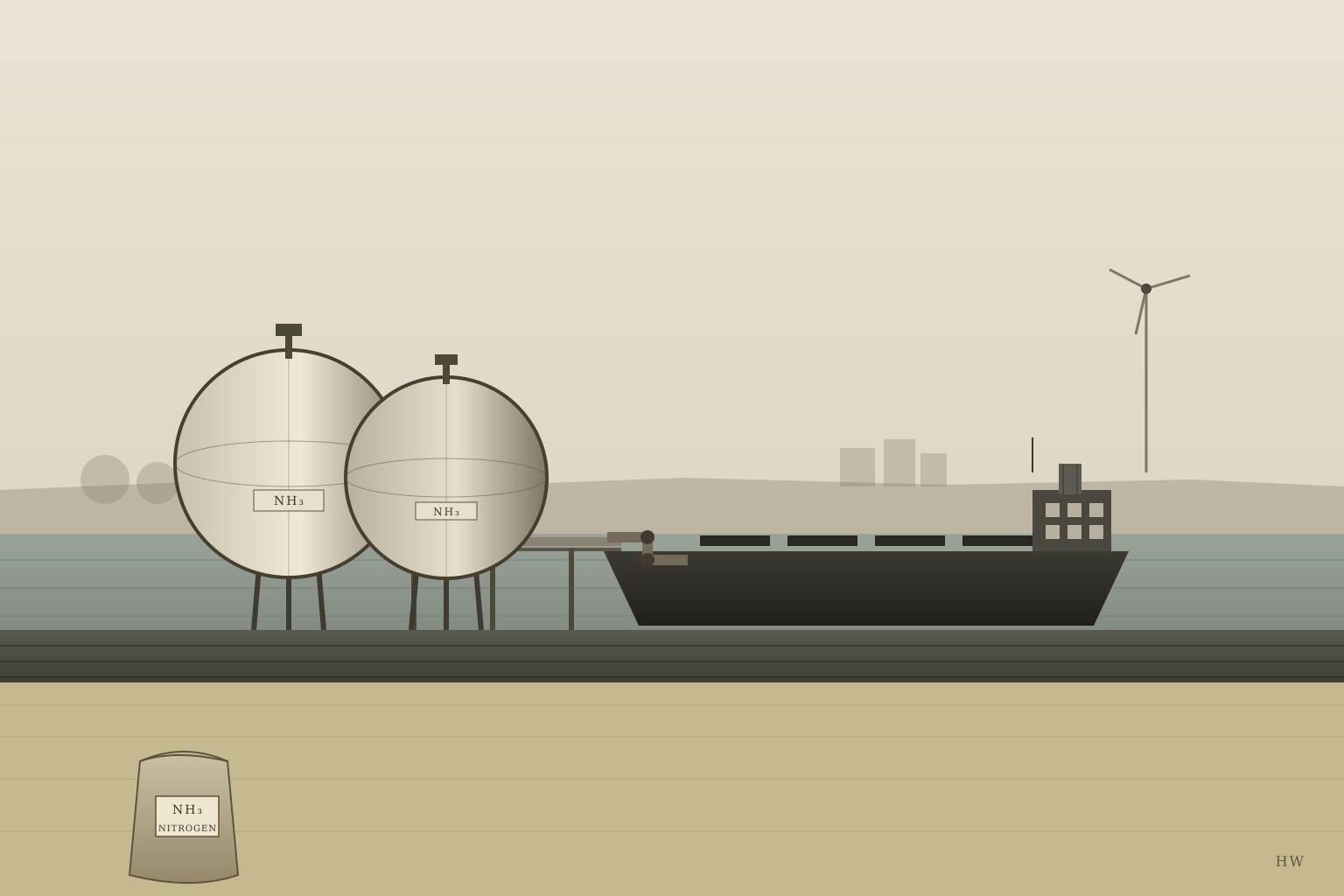
Three things happened almost quietly in the last twelve months. Europe closed more ammonia capacity. The IMO opened the legal door for ammonia cargo to be used as ship fuel. And the Gulf, North Africa, India, and Australia moved from press releases into construction on renewable-ammonia export terminals sized in the millions of tonnes. Put in a line they describe a structural handover: the plant that used to be a factory next to a farm belt is becoming a port next to a wind farm.
Europe is losing the plant
The European retreat is the plainest part of the story. Yara, the continent’s dominant nitrogen firm, has announced the shutdown of its 400,000-tonne-per-year ammonia plant at Tertre in Belgium. The site will keep producing nitrate fertilizers, but from ammonia bought elsewhere. BASF idled Ludwigshafen ammonia capacity in early 2023; roughly 2,600 jobs were lost. CF Industries’ own 2025 filings put around a quarter of European ammonia capacity in shutdown or curtailment as of January 2025, with the region described as the “global marginal producer” and expected to stay below historical rates for the long term.
None of that is a mystery. Ammonia is essentially natural gas plus air. Sixty to eighty per cent of the cost of a tonne of European ammonia is gas. The post-2022 gas price regime made European production uneconomic against Gulf, North African, and North American producers who sit on cheap methane. Sanctions cured Europe of Russian pipeline gas and, as a second-order consequence, cured it of its own nitrogen base. The fields kept being fertilized; the ammonia was simply now shipped in.
That is Europe losing the plant the first time. It is a familiar shape by now: a strategic industrial input is dropped because the short-run price signal is bad, and the political class explains that the market has spoken. What is less familiar is that the same molecule is now being repriced as something else altogether.
The molecule is being reclassified
The IMO’s Maritime Safety Committee approved interim guidelines for ammonia use as a marine fuel in December 2024. From 1 July 2026 the amended International Gas Carrier code allows ammonia cargo to be used as fuel on board — a technical sentence with a large civilisational consequence. Sixty-four ammonia-fuelled vessels were on order as of mid-2025, split roughly between ammonia carriers and bulk carriers, and dual-fuel two-stroke engines from Everllence, WinGD and J-Eng are being delivered from 2025 and 2026. Rotterdam ran its first meaningful ammonia bunker transfer in 2025; Singapore and Rotterdam now rate themselves at Port Readiness Level 6–7 for ammonia; Japan has ordered a dedicated bunker vessel.
None of this is yet a shipping revolution. Ammonia is toxic, corrosive, and difficult. But it is by an order of magnitude a more plausible zero-carbon shipping fuel than hydrogen, and the shipping decarbonisation deadline is now inside the planning horizon of every yard, class society, and port authority in the world. Once fleet capex begins moving toward ammonia dual-fuel — and it has — the demand curve for ammonia stops being a curve about crop cycles and starts having a marine tail attached.
A parallel reclassification is happening in energy. Renewable electricity is stranded by geography; ammonia is a chemically dense way to walk that electricity onto a ship. The NEOM Green Hydrogen Company in Saudi Arabia, an ACWA-Air Products joint venture, is around 80 per cent built and targets up to 1.2 million tonnes per year of renewable ammonia. Oman’s SalalaH2 is designed for 1 million tonnes, powered by 5 GW of dedicated wind and solar and 2 GW of electrolysers. India’s AM Green Kakinada project is aiming at 1.5 million tonnes. These are not gestures. They are export ports being built to send electrons in molecular form to places without them.
The map is consolidating around three coasts
Read the retreat and the buildout together and a map falls out. Ammonia production is consolidating around three kinds of coast: cheap-gas coasts (Gulf, US Gulf, Trinidad), cheap-renewables coasts (NEOM, Oman, Western Australia, parts of Chile), and phosphate-adjacent coasts where the wider nutrient system has its own logic (Morocco’s Jorf Lasfar, increasingly integrated with green ammonia ambitions). Europe is on none of those maps as a producer. Its role is buyer and, at the margin, importer of blue and green molecules made in someone else’s exclusive economic zone.
Morocco is worth pausing on. OCP holds around 70 per cent of world phosphate reserves and around 31 per cent of the phosphate fertilizer market. It targets 20 million tonnes of fertilizer output by end-2027, with 5.25 billion dollars earmarked for capex in 2026 alone, and raised 1.5 billion in an April 2026 hybrid bond. When China suspended phosphate exports through August 2026 to protect its domestic supply, OCP became the residual global supplier. That is a fertilizer story on the surface. Underneath it is a story about who gets to feed which client states through the next fertiliser cycle, and on what political terms.
India, Brazil, and swathes of Africa are the demand side of this map. Their fertilizer import bills are now being negotiated inside a supply system dominated by Morocco for phosphate, Russia and Canada for potash, and the Gulf plus North Africa for nitrogen. This is not the “globalised market” of the 1990s. It is a concentrated supply cartel with visible political overlays, in which food security has explicit foreign policy dependencies.
What Europe has actually done
The candid version of Europe’s position is this: it now imports its nitrogen, will increasingly import its future clean shipping fuel from the same handful of coasts, and lobbies for its own fertilizer industry to be shielded inside the Carbon Border Adjustment Mechanism. Yara has already signalled that it may drop its planned US low-carbon ammonia project if fertilizer is excluded from EU carbon-levy protection. The joint BASF-Yara low-carbon ammonia venture on the US Gulf Coast was cancelled in August 2025.
The FertigHy initiative — the pan-European push for low-carbon fertilizer manufacturing using renewable ammonia — is real and interesting, but it is starting the race at least a full cycle late, into a global market whose export capacity is being built by others. A continent that lost its ammonia base for reasons of gas price is now trying to rebuild it for reasons of climate policy, without the input economics that made the first version work.
This is Europe losing the plant a second time. Not by shutting it — the plants are already shut — but by failing to be present at the point where the same molecule is being redefined as strategic infrastructure. The Gulf and North Africa are not making a fertilizer for European farmers. They are making a fuel and a carrier of hydrogen for a decarbonising world, and treating fertilizer as a valuable by-line of an energy business.
The second-order effects
Four consequences follow, and each is more consequential than the fertilizer price line in a farm-lobby briefing.
First, marine fuel geopolitics will begin to inherit fertilizer geopolitics. The same tanks, jetties, pipelines, and safety regimes will serve both markets. Whoever controls the bunker will also shape the fertilizer flow, and vice versa. This tightens the leverage held by the Gulf and by port cities that get ammonia bunkering right early — Rotterdam, Singapore, Ulsan.
Second, food security becomes an energy-transition variable. If green ammonia scales, ag will compete with shipping and with hydrogen buyers for the same molecule. Prices will be set by the marginal industrial buyer, not by the marginal Bavarian farmer. Poorer importers — Egypt, Bangladesh, sub-Saharan states — will feel that first.
Third, the credibility of European strategic autonomy narrows further. A continent that imports its gas, its ammonia, its future clean shipping fuel, and its phosphate is not a strategic actor in this stack. It is a customer with a rulebook. The rulebook may be sophisticated. It is not the same thing as capacity.
Fourth, the industrial policy question in Europe is no longer whether to protect fertilizer. It is whether to treat ammonia as an energy asset and build port-scale terminals, dual-fuel bunkering, and renewable-linked electrolyser capacity around it while the classification is still open. That would mean fewer speeches about strategic autonomy and more concrete near ports.
The molecule is telling on us
There is a Taoist reading available here, and it is not decorative. Ammonia is one of those low, unglamorous substances — like water, like grain, like sand — whose movements quietly organise civilisations. The high political speech goes elsewhere. The molecule keeps its own accounts. It rewards places that make it, ship it, and understand it, and it withdraws from places that decide it is beneath their concern.
Europe stopped making its ammonia because gas got expensive and because the topic sounded unimportant. It will re-import that same molecule for its bread, its steel, and eventually its ships. The Gulf, North Africa, India, and Australia are building the ports. China holds a large share of phosphate and the ability to switch it on and off. The United States sits on cheap gas and now openly wants blue ammonia to be an industrial policy. That is the map. It is being drawn in tanks and jetties and cranes, in the vernacular language of ports rather than in the ceremonial language of summits.
A continent that cannot make its own fertilizer, cannot make its own next-generation ship fuel, and cannot make its own phosphate should probably stop calling itself sovereign in the same tone it did twenty years ago. The molecule has already told on us. It is a matter of whether the political class will still be pretending, in five years, that this too was somebody else’s emergency.
Sources
New Ag International, Yara set to close ammonia capacity at Belgium plant — used for the Tertre plant closure and the shift to imported ammonia for nitrate production.
https://www.newaginternational.com/specialty-fertilizer/yara-has-announced-that-it-is-closing-its-400000-t-y-ammonia-plant-at-tertre-belgium/
CF Industries Holdings, Form 8-K, FY2025 earnings — used for the January 2025 European ammonia curtailment figure and the “global marginal producer” framing.
https://www.sec.gov/Archives/edgar/data/1324404/000132440425000004/cf-02192025_ex991xearnings.htm
BASF, BASF and Yara end joint project for low-carbon ammonia at U.S. Gulf Coast (August 2025) — used for the cancellation of the US Gulf Coast low-carbon ammonia project.
https://www.basf.com/global/en/media/news-releases/2025/08/p-25-164
Bloomberg, Yara May Drop US Project If Fertilizer Excluded From EU Carbon Levy (January 2026) — used for the CBAM-linked signalling on Yara’s US ammonia plans.
https://www.bloomberg.com/news/articles/2026-01-12/yara-may-drop-us-project-if-fertilizer-excluded-from-eu-carbon-levy
Ammonia Energy Association, IMO moves forward with interim guidelines for ammonia fuel use — used for the December 2024 MSC 109 outcome, the interim ammonia fuel guidelines, and the 1 July 2026 IGC code change.
https://ammoniaenergy.org/articles/imo-moves-forward-with-interim-guidelines-for-ammonia-fuel-use/
Ammonia Energy Association, Ammonia bunkering: moving from demonstrations to operations — used for the Rotterdam and Singapore port readiness ratings and Japan’s bunker vessel order.
https://ammoniaenergy.org/articles/ammonia-bunkering-moving-from-demonstrations-to-operations/
Ammonia Energy Association, NEOM Green Hydrogen: Construction 80% complete for Saudi-based renewable ammonia facility — used for the NEOM 1.2 Mt/y capacity target and the construction status.
https://ammoniaenergy.org/articles/neom-green-hydrogen-construction-80-complete-for-saudi-based-renewable-ammonia-facility/
Middle East Institute, Morocco’s New Challenges as a Gatekeeper of the World’s Food Supply — used for OCP’s reserve share, market share, and the strategic framing of Moroccan phosphate.
https://mei.edu/publication/moroccos-new-challenges-gatekeeper-worlds-food-supply-geopolitics-economics-and/
Africa.com, Morocco’s OCP: The Quiet Giant Reshaping Global Fertilizer Supply in 2026 — used for the 20 Mt/y 2027 target, the 5.25 billion dollar 2026 capex line, and the April 2026 hybrid bond.
https://www.africa.com/business/moroccos-ocp-the-quiet-giant-reshaping-global-fertilizer-supply-in-2026
Ammonia Energy Association, FertigHy: reducing dependence on fossil-based fertilizers in Europe — used for the European renewable-ammonia fertilizer initiative reference.
https://ammoniaenergy.org/articles/fertighy-reducing-dependence-on-fossil-based-fertilizers-in-europe/
Image: original editorial illustration commissioned for HW — a coastal ammonia terminal with storage spheres, a jetty pipe running to a docked bulk carrier, a wind mast beyond, and a small fertilizer sack in the foreground for scale.